
By: Warren George
Published: November 27, 2025
Last updated: November 29, 2025
Tipping is a topic that never fails to spark a vivid conversation, either with Italians or visitors, and is something I’ve been asked about many times. This guide is based on my years of living in Italy and includes the answers to common questions, cultural expectations and everything between, and my tipping guidelines for restaurants, hotels, tour guides, taxi drivers and more.
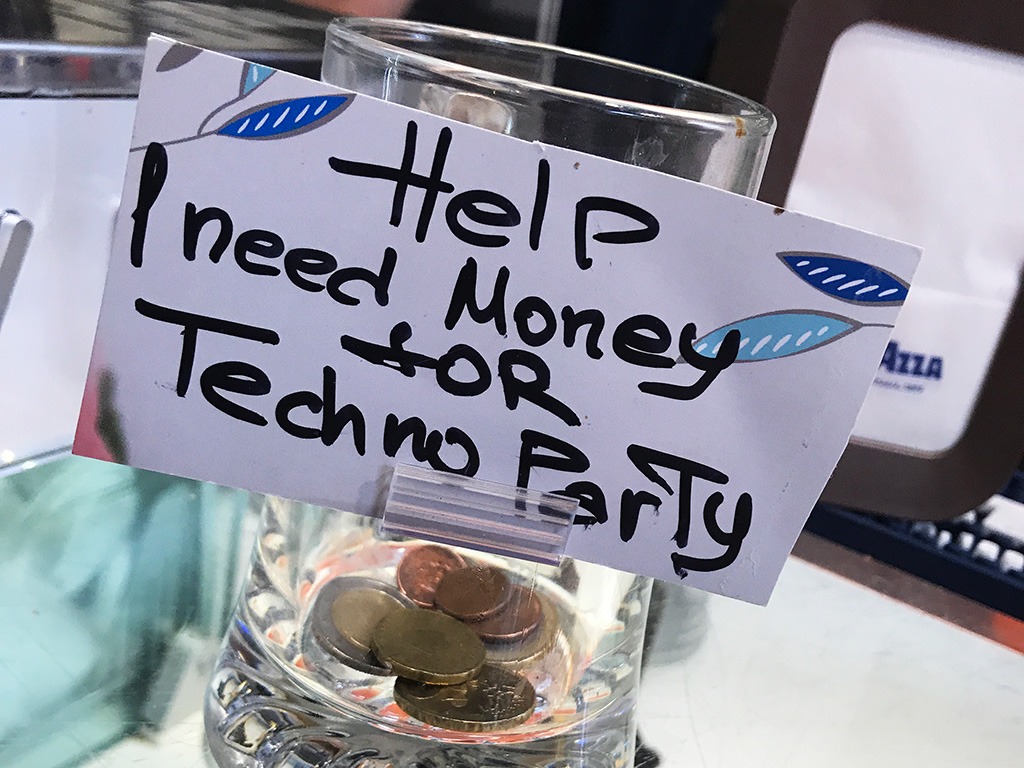
Italian’s don’t take tipping too seriously in my experience, as evidenced by this tip jar I spotted in Rome
To tip or not to tip, and other questions answered
I originally intended to talk about tipping in Italy in my series ‘Read this before you come to Italy’ but once I started putting pen to paper (or fingers to keys), it quickly became apparent that a more detailed guide was needed.
The information contained within this handy guide is universal to wherever you are in Italy. From north to south, east to west, the islands to the mainland, tipping in Italy is generally the same in my personal experience. With this, let me share with you:
The headlines about the tipping culture in Italy
Let’s start with three fundamentals about tipping in Italy before jumping in to specific scenarios and situations:
- Tipping is not legally required in Italy, nor generally expected by Italians or anyone working in Italy
- Italy does not have a legal minimum wage or living wage (like the UK) for workers, but nor do businesses (again, generally) hire staff on the basis that they will be paid exclusively via tips. Employees in Italian service industries will commonly be members of trade unions which work with businesses and regional governments to set universally applied wage rates for specific skill-sets and geographic areas.
- Due to Italy’s popularity with American visitors (where there is a strong tipping culture in the US) there is a common misconception that not tipping could be considered rude in a hotel/restaurant/taxi etc – this is not true. Take my word, after having lived here since 2019, and having travelled to all of Italy’s twenty regions extensively, I’ve not once encountered anyone who has been offended when I haven’t left a tip.
What are service charges, and cover charges in Italian restaurants?
These two items which appear commonly on restaurant bills – service charges and cover charges – are something that nearly all guests that come to Italy ask me and Sara about. Let’s look at each:
Service charges
A service charge is a pre-determined amount (normally a percentage ranging from 10-15%) that is applied to your final bill to cover the costs associated with providing you with the service advertised, i.e. dining in a restaurant. This is not universal in all Italian restaurants, so if you are unsure, be sure to enquire with the team before beginning your meal.
Service charges are discretional by law; you do not have to pay it if you feel the service you’ve received doesn’t meet your expected standards. Any applicable service charge should be clearly advised by the restaurant, normally on the menu. If it is not advised prior to ordering, you can legitimately refuse to pay it.
This fee will be collected by the establishment and typically shared equally with all team members.
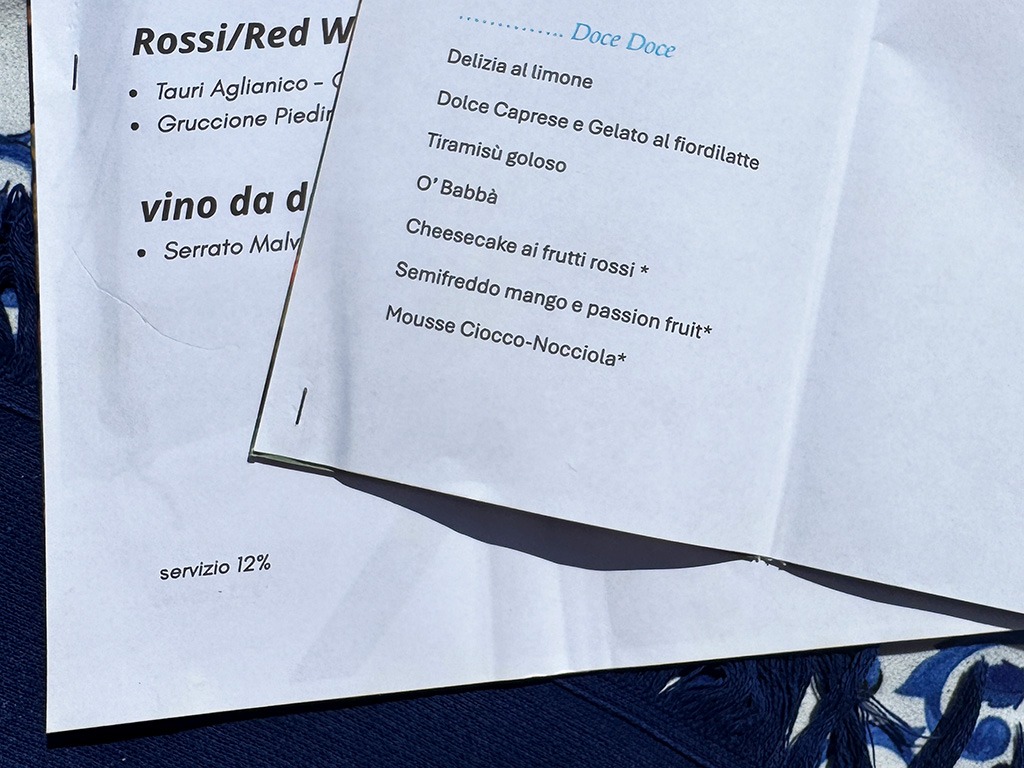
Service charges are typically noted on menus, such as this example from Naples where you can see it in the bottom left corner (12%)
Cover charges
A cover charge (which commonly appears as ‘coperto‘ on checks) is a line item to cover the cost of providing you with essentials of dining in Italy; tableware, bread, olive oil and other condiments.
Nearly all sit down restaurants will charge a coperto, which is normally a fixed rate per person, and like service charges will almost always be noted on the menu that you look at prior to ordering.
Cover charges are legal, and unless contested on the grounds that you did not receive the basics for dining, or were unhappy with the quality of the accompanying bread (for example), should always be paid when the bill comes.
In neither case do these charges replace tipping, and are not negotiable unless you are contesting the overall quality of the experience/food during your meal.
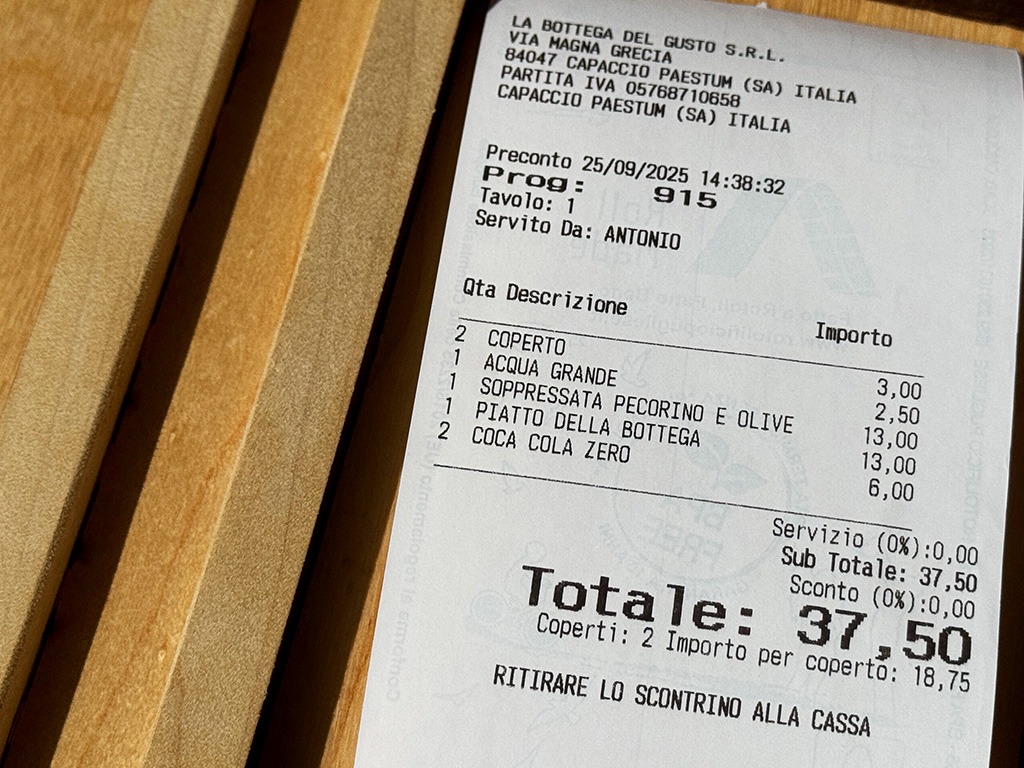
The ‘coperti’ are noted clearly here first on the bill from this restaurant in Paestum
When should you tip in Italy?
This is a potentially contentious topic as there is neither a legal requirement or cultural expectation (generally) to tip in Italy, so you should never feel compelled to give a tip.
To be honest, I do not tip often, especially relative to how much I travel, and this is for the aforementioned reasons. I see tipping as a reward for a service that goes above and beyond, and not as an expectation for services/goods provided in the regular course of business where staff are being paid a legal and fair wage.
That said, there are two scenarios for me personally in which I will tip, and believe that I personally strike a good balance on the Italian etiquette when doing so:
If I have received exceptional service, that goes above and beyond my expectations, I will tip generously. Remember that almost everyone working in hospitality in Italy is receiving a baseline wage, and are not reliant on tips for their income. Therefore, if someone, or something excels what you were anticipating, such as the quality of the food or the attentiveness to special needs, you should consider leaving a tip.
I personally value friendliness and authenticity and believe these are key to any travel experience. If I have received a nice and genuinely positive service (without being overbearing or intense) from someone, whether a waiter, driver or guide, I will generally leave some kind of tip.
How much should you tip in Italy?
In all cases, how much to tip is up to you. There are no amounts that are commonly considered as ‘good’ or ‘bad’, which can make deciding how much to give admittedly tricky. Here are some real-world examples to help you gauge how much to tip:
- In the case of a taxi costing 19€ on the meter, rounding up to 20€ if the journey was smooth would be considered good. This would scale based on the cost of the journey; for a trip with a total of 90€, an extra 10€ would be sufficient to recognise a positive or friendly service.
- For casual restaurants and bar staff, a personal token of appreciation in the form of a few coins is always welcome. This is a good way to get rid of small change and not something staff expect for a quick lunch or aperitivo. There are often tip jars for small change too in bars and cafes.
- In more formal or higher end restaurants, or ones where you are spending a higher amount, adding around 10-15% is appropriate if you feel a tip is warranted.
- If you’ve completed a private full day tour where the guide has handled everything for you from the moment you arrived to the moment you left, and kept you engaged and interested, a generous tip is common. When Sara and I have done private tours just the two of us, tipping the guide 100€ is fair for a full day tour, but for larger groups or shorter tours we may do a little less.
Tips intended to thank someone personally for an excellent service received should be paid directly in cash to them to increase the likelihood that they benefit from your generosity.
Tips often cannot be paid by card, but when they are charged this way, they will most likely be split with other team members. While I agree with this approach in some cases, it’s important to recognise when someone has gone above and beyond for you as an individual.
Tipping in restaurants in Italy
A lot of the information already covered previously applies to restaurants, but there are a handful of further things I’d like to share with you:
- Locals simply round up to the nearest euro in a lot of cases when dining out casually, as a means to say thanks but also to avoid collecting small coins. As the saying goes; when in Rome (or anywhere else in Italy for that matter), do as the Romans do (or the locals).
- Service charges are sometimes a bit higher in fancier restaurants and fining dining establishments; this is to reflect the elevated level and the higher standards of food and drink you should receive. You can expect nicer places to add a service charge between 15-25% on the final bill.
- For group dining, many restaurants may add a service charge when there is not one listed for tables generally under 4 or 6 people. When planning meals for a large group be sure to confirm the service charge in advance so it doesn’t arrive unexpectedly on your check.
- Many restaurants do not have the ability to add tip amounts on top of the bill amount when charging credit or debit cards, so make sure to have some Euro notes with you so you can leave a tip if you receive good service.
Tipping in Hotels
Tipping hotel staff is something I actively encourage if you stay somewhere for a few days and receive good service. Doing so shows your appreciation to team members (even though, again, there is no expectation or legal need to tip) and means, based on my experience, that staff are much more likely to go out of their way to ensure you have a comfortable stay.
I have found from personal experience that gifting a small cash tip of a few euros here and there to hotel porters or housekeeping staff (as well as the bar and restaurant staff) is deeply appreciated and if you return to the same hotel on your next trip, I guarantee the team will remember you!
If you find at the end of your trip you only have foreign currency or small change available to tip with, don’t worry – nothing is expected and anything is considered polite, even one Euro.
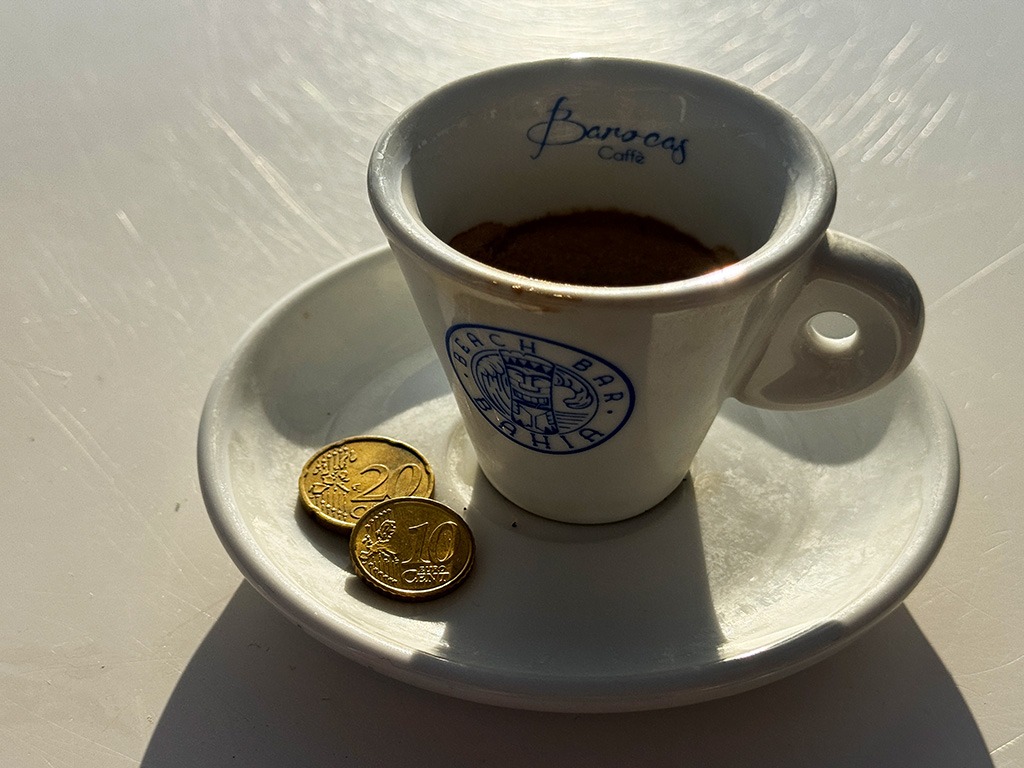
Just as leaving a few coins at a cafe for small things like a coffee is considered generous, the same applies at hotel bars
Tipping taxis and drivers in Italy
Like with all other services, tipping taxi drivers or private hire drivers is neither expected nor required. That said, rounding up a fare to the nearest euro (for shorter rides) to the closest ten (for longer journeys) is my go-to approach for drivers. This assume the service was comfortable and efficient of course!
Increasingly, taxis across Italy are using card machines to accept payment, where there is rarely an option to add a tip. Therefore I would recommend ensuring you have small bills or loose change available when taking a car somewhere if you plan to give the driver a tip.
In the case of apps like Uber or Freenow, I would advocate for leaving a small tip via the app or in cash direct to the driver, as those services take a large percentage from the ride total before passing on the remaining payment to the driver.
One important note; it is not legal for any taxi driver in Italy to request a tip (it should always be offered by the passenger), or charge extra for services such as loading/unloading luggage in to their cars for you. This petty scam used to be fairly common in tourist areas of the country, but with the authorities cracking down on drivers and general awareness improving, you are unlikely to come across this, but at least if you do now, you know that you can refuse to pay.
Tipping for Tour Guides
Tour guiding is one profession and line of work that I believe should be tipped more, as they provide an expert and highly-skilled service.
I believe regardless of the tour type you are on – group or private – recognising your guide with a tip at the end of your experience demonstrates an acknowledgement not just of the work they have done that day, but the time they have invested previously in training to be a guide.
In the event that you are part of a large group, around 5-10€ would be sufficient and appreciated.
For private experiences, consider gifting your guide something more substantial based on the tour length and complexity. For half-day tours I would recommend 20-50€ per person, and for full-day experiences consider 50-100€ (per person), depending on the number of people in the group and how involved the tour was.
To summarise
Tipping in Italy is not the minefield that some people believe. Remember that is not required or expected, and therefore anything you tip to anyone when here will be appreciated. If you have any questions about Italian culture or need help planning a trip here, don’t hesitate to contact me.