

By: Warren George
Published: November 12, 2025
Last updated: September 24, 2026
Taormina in Sicily is one of those quintessential Italian destinations that conjures up images of La Dolce Vita – The Sweet Life. I’ve been visiting since 2014 and as such have got to know this small town perched on Sicily’s north-eastern coastal cliffs pretty well. Let me share with you my personal insights, recommendations, travel tips and more in this detailed guide.

Taormina is one of those destinations in Italy that everyone should visit at least once – let me share with you where to stay, how to get here, the best places to eat and drink and more
Taormina, Sicily: What to do, where to stay, food and drink, and much more
With panoramic views of the Ionian Sea, crystal-blue waters, pristine beaches, history stretching back over 2000 years and some of the best food in Sicily, Taormina is one of my all-time favourite Sicilian towns.
This doesn’t even include the fact that Taormina is the perfect base for exploring Sicily, with road and rail connections beyond the immediate area, including Europe’s most active volcano, Mount Etna.
After years of visiting this iconic location I can confidently share the following:
A brief history of Taormina
Taormina’s documented history can be traced back to the 400s BCE when indigenous locals founded a settlement at the top of Monte Tauro, recognising its strategic and defensive value in the face of aggression from the Greek city-state of Siracusa (roughly 120km south of Taormina).
In the following centuries, Greek colonists settled in Taormina which became a wealthy city benefiting from the trade between the various Greek city-states in Sicily and southern Italy.

It is easy to see why this spot was chosen for a town when the views of the local area – perfect for defending your homes – are as expansive as this
Arrival of Rome, the first tourists, and then the Arabs
Following the conclusion of the First Punic War (264–241 BCE) between Rome and Carthage (a maritime trading empire based in modern-day Tunisia) in Rome’s favour, Taormina and the rest of Sicily became part of the Roman Republic and later the Roman Empire.
During this time, Taormina became a popular tourist destination for the rich and renowned of ancient Rome, who came here seeking the natural beauty and seclusion that this part of Sicily offers.
Roman control of Taormina remained largely in place until the mid-900s CE, during which time the existing Greek monuments were embellished and expanded, such as the famous Greek/Roman theatre of Taormina.
Following the slowly loosening control of the Eastern Roman Empire, the town and the whole of Sicily were conquered by the Fatimid Caliphate with Taormina being the last stronghold to give out to the invaders in 902.
Enter the Normans, Angevins and Iberians
Arabic control lasted for just over 100 years, after which the island was conquered by the Normans, who arrived from the Italian mainland – the same group of nobles and mercenaries originally from northern France who conquered England in the late 1000s.
Norman control of Taormina, and the rest of Sicily lasted until the end of the 1100s after which time the island was taken over. First by the House of Hohenstaufen (the Holy Roman Empire) and then within a short space of time, by the Angevins from France.
In 1282, following a revolt by the people of Sicily, Angevin control collapsed and was ceded to the Aragonese, the ruling power of Catalonia (modern-day Spain) at the time. This ushered in a period of Iberian control that lasted until 1735 (with some brief interludes where competing powers vied for mastery over Sicily), when Charles of Bourbon, son of Philip V of Spain, conquered Sicily and southern Italy.

Many of the town’s famous landmarks were built during the Aragonese and Spanish periods of control over Sicily
Bourbon control and Italian Unification
Charles of Bourbon established a new kingdom seperate from Spain, comprising all of Sicily including Taormina and southern Italy (from Naples south) which came to be known as the Kingdom of the Two Sicilies.
Under the stewardship of the Bourbons the kingdom flourished and became one of the most influential states in the Mediterranean.
This wealth and power made the Kingdom of the Two Sicilies one of the first targets for Garibaldi in his campaign to unite Italy under the Savoys in the mid-19th century. In 1861, Sicily was brought fully under Savoy control, and it was only a few years later that a united Italy was proclaimed.
Modern times
During the 19th century, and particularly following the unification of Italy, Taormina was rediscovered by travellers who recognised its beauty and historical significance.
This was at a time when wealthy visitors from western Europe were making their way to Italy to undertake what was known as the ‘Grand Tour’ – extended trips to some of Italy’s most famous spots, seeking art, culture and indulgence in the country’s famous food, drink and lifestyle.
For most, this journey typically ended in Naples and Sorrento, but the most adventurous continued further south, arriving in Sicily. Taormina was rediscovered during this period and has remained a popular tourist destination ever since.
”Were a man to spend only one day in Sicily and ask, “What must one see?” I would answer him without hesitation, “Taormina.” It is only a landscape, but a landscape where you find everything on earth that seems made to seduce the eyes, the mind and the imagination.
Guy de MaupassantFrench Author
Thankfully, Taormina was spared major damage during the Second World War, especially when compared with Messina and Catania, which were bombed heavily during Allied air campaigns. During Operation Husky, the Allied campaign to liberate Sicily, Taormina was used as a rest and relaxation destination for recovering Allied soldiers, as well as a communication base. The town’s role as a place where those injured during the war found peace no doubt helped the town rebound in the 1950s and 1960s, when it quickly became one of Italy’s go-to destinations for American and British tourists.
Most recently, Taormina has become world-famous for its role in The White Lotus, season two (2021). This has led to an increase in visitors which has in turn boosted prices for accommodation, restaurants and beaches, but hasn’t diminished the town’s appeal as a cultural destination.

One of our favourite things to do in Taormina is to simply wander; the beautiful streets and piazzas make exploring a joy at any time of year
When is the best time to visit Taormina?
I’m happy to visit Taormina at any point in the year. You’ll always find great places to eat and drink, shops ready to welcome you, and famous views of Etna and the Mediterranean Sea.
That said, when I’m free to choose, I come to Taormina in either late May or late September. These points in the year offer the best of everything in my experience – generally good weather, warm enough for a beach day and sightseeing without being too hot, and smaller crowds compared with the height of summer.
Visiting during the summer (high season) will mean crowds almost daily (as Taormina is also a popular location for cruise stops/excursions) and temperatures can get very high, which can make exploring uncomfortable.
Conversely, during the winter months (low season), Taormina all but empties of tourists which makes enjoying the town’s scenery and architecture more relaxing, but you may find that some restaurants, shops and hotels are closed.

Regardless of when you are coming, you can enjoy Taormina’s stunning scenery and unique culture
Getting to Taormina
Taormina’s position in north-east Sicily, close to the Italian mainland, makes getting here fairly easy – here are your main options:
By air

Catania’s airport is a hub for connecting to the rest of Sicily, including Taormina
Another option is to fly to Palermo Falcone Borsellino Airport (PMO) and then travel onwards to Taormina. The journey from Palermo airport to Taormina takes around 3.5 hours on average by road, but it’s also possible to use trains and/or buses – the latter option, however, will take longer, with journey times averaging closer to 5 or 6 hours.
It’s worth noting that most of the larger hotels in and around Taormina will be able to arrange transfers for you.
By rail
Taormina is one of the few locations in Sicily that can be reached easily by rail. The train station for Taormina is located a short distance outside the main town, at Via Nazionale 43, and offers travellers connections north to Messina (where you can connect further to the Italian mainland via the train ferry crossing at Villa San Giovanni in Calabria), and south to Catania and Siracusa.
By road
Driving to Taormina is straightforward, as it is located just off the E45 autostrada (motorway/freeway). By road the town is situated less than an hour from Messina (for connection to the Italian mainland) and just over an hour from Catania.
The main road that runs through the newer part of Taormina (Via Nazionale) flows well and connects the town to the beaches at Giardini Naxos, and is fun in its own right if you enjoy driving as much as I do.
If you’re coming to Taormina with a car, or are planning on hiring one while here, be sure to bear in mind that parking can be a challenge without preparation, depending on where you’re staying. However, I’ve got you covered after years of trial and error on past visits…
Driving in Italy isn’t half as bad as some of the stereotypes make out. By understanding a few fundamentals you can explore this incredible country by car, without the stress. Find out everything you need to know about getting on the road in Italy in my detailed guide here:
Parking in Taormina
If you’re staying at a hotel or rental outside the main town, you’ll be able to find a spot to park your car relatively easily in my experience. My go-to car park if I don’t have access to one via my accommodation is Mazzarò Car Park at Via Nazionale 147. Not only is it easy to reach and fairly priced (considering its prime location), but it also provides immediate access to the cable car that transports visitors and locals to and from Taormina’s old town.
However, if you’re staying in the historic centre of Taormina, finding parking can be difficult; the compact streets and town’s elevated location make space for vehicle parking very limited. In this instance I’d recommend parking away from the main town and then taking a taxi or using the cable car to reach your accommodation.

The Mazzarò car park is a convenient and fairly priced option for parking a car, with immediate access to the cable car for the historic center of Taormina
Where to stay in Taormina, and nearby
Taormina is a small town compared to Sicily’s main population centres (Palermo, Catania, Messina, Siracusa) but that doesn’t mean there isn’t plenty of choice when it comes to finding somewhere to stay.
This is due to its legacy as a popular holiday spot for decades, and the fact it’s located close to points of interest such as Mount Etna. Let me break down your main options for where to stay during your trip:
Historic centre
Located at the top of Monte Tauro, Taormina’s historic centre features grand 5-star hotels such as the San Domenico Palace, boutique B&Bs and varied rental options.
Given the limited space in the old town and the proximity of popular sites like the ancient Greco-Roman theatre, plus the sweeping views of the Mediterranean Sea and Mount Etna, prices per night in all accommodation types in the town centre are above the Italian average.
I’d recommend staying in the centre if you have limited time and want to make the most of your stay in Taormina, or are travelling without budget considerations.
Beyond the town centre
At the base of Monte Tauro, the town of Taormina continues with more modern architecture, where you’ll find mid-range hotels, regular bed and breakfasts and more self-catering options.
When Sara and I travel to this part of Sicily we tend to stay in this area, as rates are lower per night on average, and we can still access the historic centre easily using the reliable cable car.
Staying near Taormina
By venturing beyond the official boundaries of Taormina you’ll find all types of accommodation available, generally at a lower rate per night compared to the above options.
The nearby town of Giardini Naxos is a great option for those looking to visit Taormina, but also explore the wider area, and enjoy some of Sicily’s best beaches – take a look at your options here:
For a more detailed and comprehensive rundown of the key areas to stay in, and nearby, Taormina Sicily, ready this guide:
What to do in Taormina
There’s no shortage of things to do in Taormina, with options to suit most travel styles, budgets and interests. Here’s an overview of the top activities:
For history and culture
Taormina’s star attraction is the Ancient Roman/Greek theatre situated on the slopes of Monte Tauro in the centro storico (historic centre) of the town.
This ancient theatre was built in the 3rd century BCE, and it’s easy to see why the Greeks chose the location; the backdrop is sweeping views of the Ionian Sea and Mount Etna. It was embellished by the Romans and maintained through Byzantine control of Taormina and Sicily, meaning it is one of the best preserved ancient Greek theatres anywhere in the world.
Private Taormina Tour | City Highlights Walk
Discover Taormina with an expert local guide on this entirely private tour, experiencing the city’s remarkable landmarks including the famous ancient Greek theatre

Private Taormina Tour | City Highlights Walk
Discover Taormina with an expert local guide on this entirely private tour, experiencing the city’s remarkable landmarks including the famous ancient Greek theatre

Beyond the Greek theatre, those looking to learn more about Taormina’s past should head to:
- Piazza IX Aprile (roughly halfway along Corso Umberto, the town’s main drag), which provides spectacular views of the Ionian Sea and Mount Etna, and makes the perfect place to stop and enjoy a cocktail or coffee in the late afternoon (more about this below). This historic square is ringed not only by bars and restaurants, but also by churches and remnants of Taormina’s ancient defensive structures, making it a focal point for life in the city for locals and visitors.
- At the very end of Corso Umberto you’ll find Porta Catania and Taormina’s cathedral. Porta Catania was one of Taormina’s main gates in the ancient walls that ringed the city (and remain visible in other places such as at Porta Messina), and the duomo (full name Basilica Cattedrale di San Nicolò di Bari) is a prime example of Norman Sicilian architecture, with its fortress-like style and Arabic influences in the interior.

Goethe famously once said about Taormina’s Greek theater (that) “No audience in any other theatre ever beheld such a view.” – I’d have to agree with him
Beaches and nature
One of the things that keeps calling Sara and me back to this part of Sicily is the stunning natural beauty and beautiful beaches that line the Taormina coast.
In Taormina itself you’ll find a stretch of coastline that looks out to the Isola Bella protected nature reserve. This tiny island just off the coast (connected via a small sandy causeway) was purchased in 1890 by Lady Florence Trevelyan, a British conservationist. She also created what would become Taormina’s municipal public gardens at Villa Comunale di Taormina, now also home to the town’s botanical gardens.
Along the beaches facing Isola Bella (accessed via stone steps from Via Nazionale) there are several stabilimenti (beach clubs) offering bed and lounger rentals. Our favourite is Mendolia Beach Club, which is reasonably priced (considering the limited beach space in this area and the high demand in the summer months) and features a great, informal restaurant with sea views – more about this below.
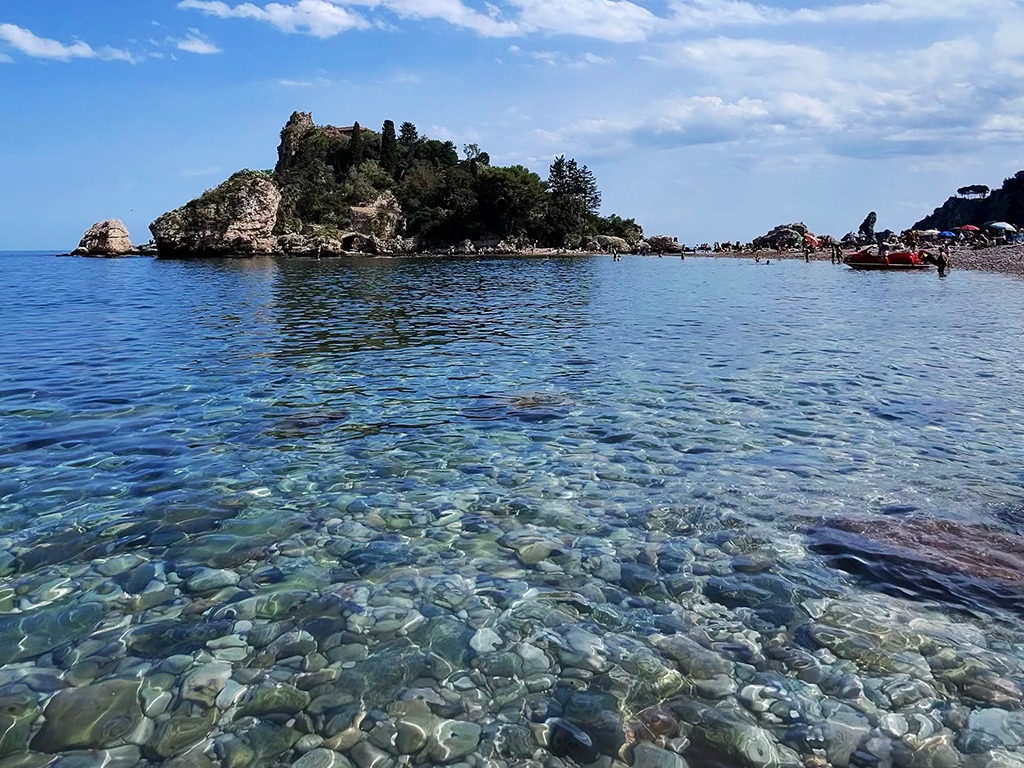
The perfectly-clear waters and Isola Bella nature reserve are a must-visit for anyone in Taormina
There is also a small section of ‘free beach’ where anyone can set up their towels on the sand and pebbles. This area connects to the Isola Bella nature reserve, so it can get extremely busy in the summer, so I’d recommend considering a spot at one of the beach clubs for the relatively low cost asked in exchange for comfort and guaranteed water access.
Along this same stretch of coast you’ll find options for boat tours, kayak hire, and snorkelling excursions for the more adventurous.
Italian beach culture took Sara and I a while to get our heads around. After living on the Roman coast for years, we’ve now mastered how to navigate sunbed rental, dress codes, swim safety, and everything else you need to fully enjoy Italy’s beaches. We share all of this so you don’t have to learn the hard way in this detailed guide on Napleswise:
Eating and drinking
I share my specific recommendations on where to eat and drink below, but as a headline, Taormina is a fantastic place for anyone wanting to indulge in authentic Sicilian cuisine. You’ll find everything from takeaway joints to regular trattorie, up to luxury restaurants offering fine-dining experiences.
Note that Taormina is a reasonably traditional town meaning you won’t find many non-Italian cuisine options, or any big chain/branded food and drink outlets.
Due to Taormina’s position on Monte Tauro, much of the town is accessed via sometimes steep inclines and steps. This can make getting around a challenge for those with mobility issues.
Day trips
If you’re spending a few days in Taormina and are keen to explore more of Sicily, the town makes a great base for day trips thanks to its convenient road and rail connections. Here are my top excursions from Taormina:
Mount Etna
Viewable from Taormina, this symbol of Sicily is just a short journey away (around an hour’s drive), offering visitors the unique opportunity to see an active volcano up close.
The best way to visit Etna will depend on your priorities, budget and time available. You’ll find no shortage of excursions on offer from tour agencies, or you can visit freely and independently.
If you’re looking for something truly memorable I highly recommend contacting Casa Mia Tours. They are a boutique tour agency who work exclusively with only the best local guides to offer genuinely unique experiences. Full disclosure: I’ve worked with Casa Mia Tours behind the scenes as part of their marketing team since 2020, but after hiking Etna with one of their expert guides in 2025 I can honestly endorse them. Find out more on their website here.

Etna’s landscape is like nothing else in mainland Europe, and hiking it makes for an unforgettable experience
Messina
Messina is Sicily’s gateway to the Italian mainland, with ferries crossing the Strait 24/7, carrying people, vehicles and even trains. This makes it a popular stopover destination for travellers going to and from Sicily and Calabria, and its proximity to Taormina (approximately 50km) means visiting is easy and convenient.
Art lovers shouldn’t miss the two paintings by the famous artist Caravaggio, painted in the early 1600s as he fled from Malta on his way back to Italy. Both are housed in the Museo Regionale Interdisciplinare di Messina (MuMe), located at Viale della Libertà, 465.
Additionally, the regular ferries and connections to the Italian mainland make visiting Reggio Calabria, home to the famous Riace Bronzes, very easy and a must for anyone interested in ancient history.

The Riace Bronzes are true masterpeices from antiquity that are impossible not to be awed by, and are easily reachable from Taormina
Siracusa/Ortigia
Heading south from Taormina along the coast of Sicily, either by car or by train (either method takes around two hours) you’ll arrive at Siracusa and Ortigia, another of my favourite spots in Sicily.
Prior to Roman control, Siracusa called the shots in this part of Sicily where it was a powerful and independent Greek city-state. By balancing the interests of Carthage, Rome and the other Greek towns of Sicily to its advantage, it was able to retain independence and wealth until 212 BCE, when it was eventually conquered by the Romans.

History lovers should take advantage of Taormina’s connections to the rest of Sicily to explore the island’s fascinating past
This legacy means that you’ll find some of Italy’s most impressive ancient Greek (and Roman) monuments just outside the modern city at the Neapolis Archaeological Park, as well as on the island of Ortigia.
Ortigia, while now officially a district of Siracusa, was the original Greek city here, and the narrow streets still follow (mostly) the original ancient layout – a lot like the historic centre of Naples in Campania.
Sara and I love exploring Ortigia, particularly in the late afternoon when the sun sets over the bay and the changing light illuminates the beautiful baroque architecture of Piazza del Duomo.
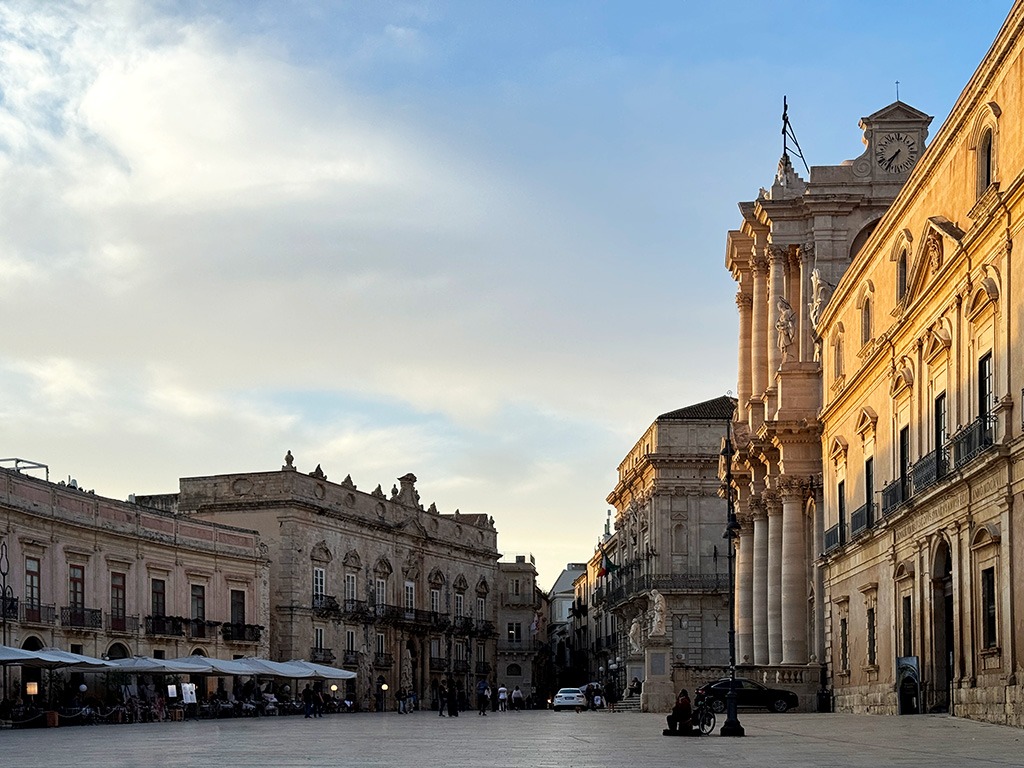
If I could live anywhere in Sicily, it would probably be Ortigia
Eating and drinking in Taormina
For a small town, Taormina is packed with fantastic places to eat and drink, and where space is limited, competition is high, which means that quality is high almost everywhere you go.
Our two favourite restaurants are located outside of the historic centre, close to Isola Bella beach:
- Bell’Assai – This traditional restaurant conveniently located on Via Nazionale just a few minutes’ walk from the cable car for the main town and beaches, serves delicious Sicilian classics such as Pasta alla Norma, complemented by great views of Isola Bella and an extensive wine list.
- Mendolia Beach Club – The perfect spot for a casual beachside lunch, we love this restaurant as it’s informal, fairly priced and offers fast and efficient service. The menu is simple but the quality of the fish is just as good as you’ll get elsewhere in Taormina, and there’s something special about enjoying the local produce just a few steps from the water.
Another spot that I love in this area is Ai Paladini, where you can enjoy one of my all-time favourite things about Sicily; authentic Sicilian granita served with a freshly baked brioche which is traditionally eaten at breakfast, but can be ordered at any time of the day.

Nothing beats a breakfast of real Sicilian granita and a freshly baked brioche
If you’re looking for recommendations in the centro storico area of Taormina, check out these spots:
- Piazza IX Aprile – The perfect place for an aperitivo with panoramic views of the Bay of Naxos and Mount Etna. Prices are higher on this piazza compared to the streets, but you’re paying for the environment and impeccable service – grab a seat at whatever spot takes your fancy and relax.
- Ristorante del Corso – This casual restaurant makes for a good lunch or dinner option for most types for travellers; their menu includes non-Sicilian (Italian) classics and they’re able to cater for dietary requirements such as gluten-free, as well as families. The central location on Corso Umberto makes it an easy option after a visit to the Greek theatre, before continuing along Taormina’s main street to Piazza Duomo or for an afternoon of shopping.

Being on the water, Taormina is a great place to enjoy fresh seafood and even simple things like mussels seem to taste better here
In conclusion…
Taormina is one of those destinations in Italy that everyone should visit at least once; there’s endless history to discover, stunning nature and beaches to enjoy, and some of the island’s best food and drink to indulge in. If you have any questions about visiting Taormina or nearby, don’t hesitate to contact me – I’m always happy to share my experiences and recommendations.