

By: Warren George
Published: May 20, 2026
Last updated: August 31, 2026
Taormina, Sicily is one of Italy’s most iconic locations. It is synonymous with La Dolce Vita, “The Sweet Life,” where spectacular scenery combines with history stretching back 2000+ years, earning it the nickname “the Pearl of the Ionian Sea”. From some of Sicily’s top beaches to must-try food and wine, there is no end to the things to do in Taormina. So much so, that choosing the top activities and experiences can almost be overwhelming, especially for first time visitors. This guide provides a complete view of what to do in Taormina, based on my years of visiting.

Natural beauty, great food and rich history combine in Taormina meaning there are near endless things to do
Top things to do in Taormina Sicily – Activities & Attractions
I’ve been visiting Taormina regularly since 2015 and consider it one of the places I know best on the island of Sicily. The main thing that keeps calling me back is the wealth of things to do, both in the historic center and nearby.
While I was first drawn here by the town’s history, I now find myself returning time after time to enjoy the pristine beaches, the hiking trails above the town, delicious local food and drink, and for the fact Taormina is the perfect location for a day trip in eastern Sicily and beyond.
This guide includes details about all of these activities, and more. You can use the links below to jump to the things which interest you the most, or keep reading for a complete overview.
Guide Contents
Who is this guide for?
This guide has been written for travellers planning a visit to Taormina who want to understand exactly what the hilltop town and surrounding area offers in the way of activities and experiences. Whether you are already in Taormina or just starting to get organised, you’ll find the recommendations featured throughout a useful starting point for planning your time here.
All information in this guide is current as of August 31, 2026, and where relevant I also include tips on transport and other practicalities. For a more extensive breakdown on getting to this part of Sicily, insights on where to stay (including top hotels and my favourite apartment rental in Taormina), and more general recommendations, refer to this guide:
Taormina Top Tips: The Fundamentals
Before jumping into my specific recommendations, I’d like to share two important pieces of information to ensure you have the best possible experience when visiting Taormina:
1. Accessibility and Mobility
Taormina sits on the side of Monte Tauro, a large mountain that is both a blessing and a challenge. The (literal) upside is that Taormina’s unique position means that no matter which way you look, you are almost always guaranteed an amazing view. Inversely, parts of the old town are steep and uneven, and many beaches are accessed via steep stairs, meaning visits to Taormina if you have mobility challenges could mean you have some difficulties getting around.

Take your time to soak up the atmosphere in Taormina, especially during the evenings, when local life focuses around the historic center and main sights
2. Money Matters
Sicily, on the whole, is much cheaper than mainland Italy and Sardinia when it comes to experiences, accommodation, eating and drinking. However, Taormina is the exception. This town is one of Sicily’s top luxury destinations and has been a popular spot for wealthy travellers since the advent of modern tourism. It has recently gained fame as the setting for the White Lotus series (season 2) where the San Domenico Palace was transformed into the White Lotus Hotel for the TV show.
It gives other famous Italian locations known for good living, such as the Amalfi Coast near Naples, a run for their money. As such, travellers should be prepared to spend a bit more to enjoy the best the town has to offer. This expenditure is rewarded in my experience, where Taormina’s service and quality – no matter what you are doing – is second to none in Sicily.
For History and Culture
Since its founding by Greek colonists in 734 BC, through the Middle Ages and up to today, Taormina has been a strategically important and incredibly wealthy town. This legacy is particularly pronounced at the following sights where Taormina’s history can be discovered:
The Ancient Greek-Roman Theatre (Teatro Antico)
The Teatro Antico di Taormina is the town’s undisputed crown jewel and one of the main reasons travellers from across the world visit this small Sicilian town. Originally carved into the limestone of Mount Tauro by the Greeks in the third century BC, it was later expanded by the Romans. The theatre remained in use during the period of Eastern Roman (Byzantine) control over Sicily before the island was conquered by the Fatimid Caliphate in 902 CE.
It is the second largest ancient theatre in Sicily (the largest being Syracuse’s – more on how to see this from Taormina below), but it’s easily the most scenic ancient theatre, possibly in the world. As you explore the tiers, the robust ancient stone columns of this ancient Greek theatre frame the stage, backed by the deep blue Ionian Sea and a perpetually present Mount Etna (pictured below, Etna on the right). Today, this Greek theater still hosts world class concerts and events, 2000+ years after it was constructed.

It was this site that first drew me to Taormina in 2015, and I still make a point of visiting it whenever I am in town.
This is a popular site, particularly with large groups of cruise ship passengers visiting Taormina on tours and day trippers coming from other parts of Sicily. With this in mind I would recommend booking your entrance in advance, either via the official website or an official partner such as GetYourGuide. It’s also important to time your visit for the optimal experience. I like to arrive first thing in the morning, which allows you to beat the heat if you’re visiting during the summer. Alternatively, you can visit late in the day, but regardless, in both cases, there will be a lot less visitors compared to the middle of the day.
Corso Umberto
Corso Umberto is the spine of Taormina, a pedestrianised stretch where the town’s ancient and medieval history combines with the modern world. As you walk along the street (800m end to end, around 15 minutes walk without stopping), you’ll pass luxury fashion boutiques, artisan ceramic workshops, busy bars and welcoming restaurants.
Beyond the shopping and indulging that can be enjoyed along this road, Corso Umberto is anchored by three must see architectural landmarks that history buffs should take a moment to appreciate:
Porta Messina
This is the northern gateway to the old town (named as it faces the city of Messina). If you’re arriving via the cable car, this is where your journey in the historic heart officially begins. Originally part of the city’s 17th-century fortifications, it now serves as the grand, stone arched entrance into the busy centro storico of Taormina for most visitors to the town.
Private Taormina Tour | City Highlights Walk
Discover Taormina with an expert local guide on this entirely private tour, experiencing the city’s remarkable landmarks including the famous ancient Greek theatre

Private Taormina Tour | City Highlights Walk
Discover Taormina with an expert local guide on this entirely private tour, experiencing the city’s remarkable landmarks including the famous ancient Greek theatre

Piazza IX Aprile
Located halfway along the Corso, this is Taormina’s main piazza – central square. Piazza IX’s checkered marble terrace acts as a magnificent balcony (and is often referred to as Belvedere di Taormina), offering a vertigo inducing view of the Ionian Sea and Mount Etna (if you go weak at the knees when high up, don’t go to the very edge of the piazza!).
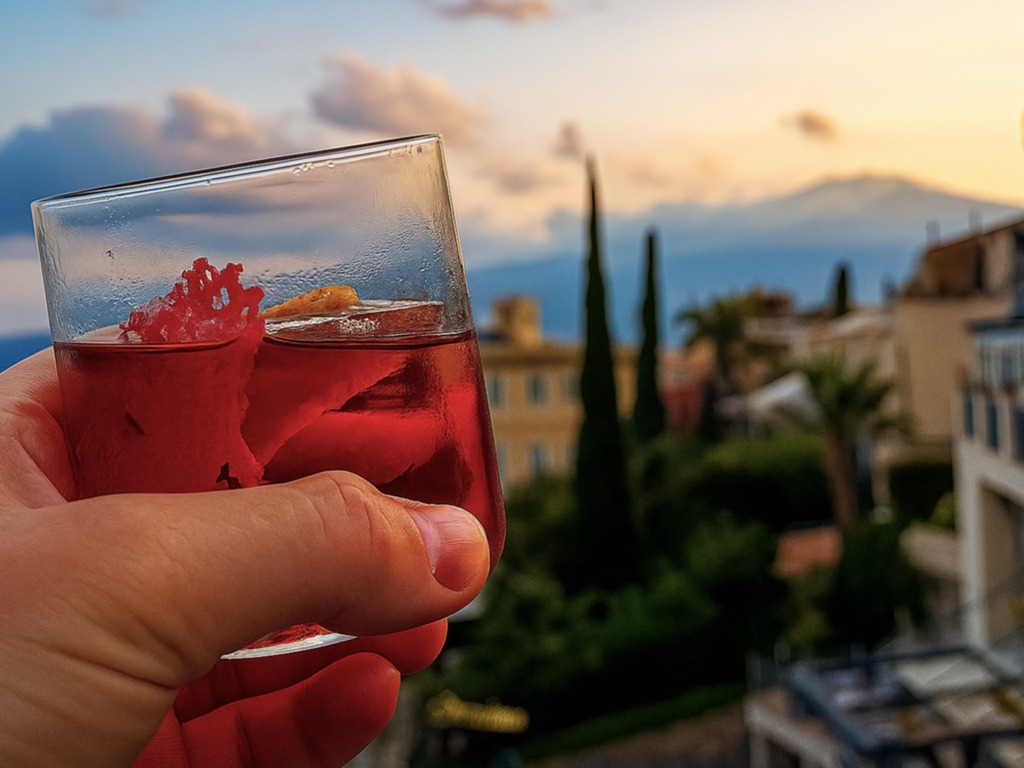
Piazza IX Aprile is one of Taormina’s ultimate aperitivo spots – I can’t resist stopping here for at least one Negroni when in town to appreciate the architecture of the piazza and the views.
Porta Catania
Marking the southern boundary (named as it faces the city of Catania), this gate signals the end of the main thoroughfare. Built in the 1400s and adorned with the Aragonese coat of arms (modern day Catalonia in Spain, previous rulers of Sicily for a time during the Middle Ages), it sits just a short walk and steps away from the Duomo/cathedral, speaking of…
The Duomo of Taormina (Cathedral of San Nicola of Bari)
The Duomo di Taormina, or the Cathedral of San Nicola, looks less like a standard church and more like a medieval fortress. Built in the 13th century BC on the ruins of an even older structure, its Norman-Gothic facade is purposefully simple. It features solid stone walls and defensive style structures along the roofline, much like Palermo’s famous Norman cathedral.
Inside, the atmosphere is peaceful and spiritual, a world away from the busy streets of Taormina, with a classic layout supported by ancient stone columns. Visits to the church are subject to mass times and religious events, as well as any of the local congregation who are using the cathedral for weddings, baptisms or funerals.
I’d recommend checking the official website for opening times, and if you are unable to visit on your first attempt, circle back later during your trip.
All of these sites could be comfortably visited in a day, or spread out across the course of multiple days allowing time to enjoy more of what Taormina and the area has to offer.
Nature and Outdoor Activities
Taormina’s position on Mount Tauro and the proximity of Mount Etna make the scenery truly one of a kind where mountains give way to the endlessly blue Mediterranean sea via dramatic cliffs. Within the town of Taormina itself there are two key locations that nature lovers shouldn’t miss:
Villa Comunale (Taormina Public Gardens)
For a serene break from the crowds of Corso Umberto and the ancient theatre, head to the Villa Comunale. These public gardens were originally the private estate of Lady Florence Trevelyan (1852–1907), an English noblewoman with a flair for the eccentric. Lady Trevelyan made the park famous for its “follies”; whimsical wooden and brick structures that look like Victorian pagodas or giant birdhouses.
The winding paths and shaded benches of the Taormina public gardens make for the perfect spot to take a pause from sightseeing and shopping, enjoying a gelato/granita while soaking up the peaceful views of the bay and Mt Etna. There is no entrance fee for the Villa Comunale, and it can be visited whenever you find the gates to the park open (usually 8am-midnight).
Isola Bella Nature Reserve
Isola Bella is a tiny island connected to the mainland by a narrow strip of pebbled sand that disappears and reappears with the tides. Once another private home of Florence Trevelyan who populated the islet with exotic plants, it is now a protected nature reserve offering unique views of the Taormina coastline.
It’s a special place to escape the town’s bustle; just remember to wear sturdy water shoes – trust me when I say this; the shingle and rocky beaches here are unforgiving on bare feet.
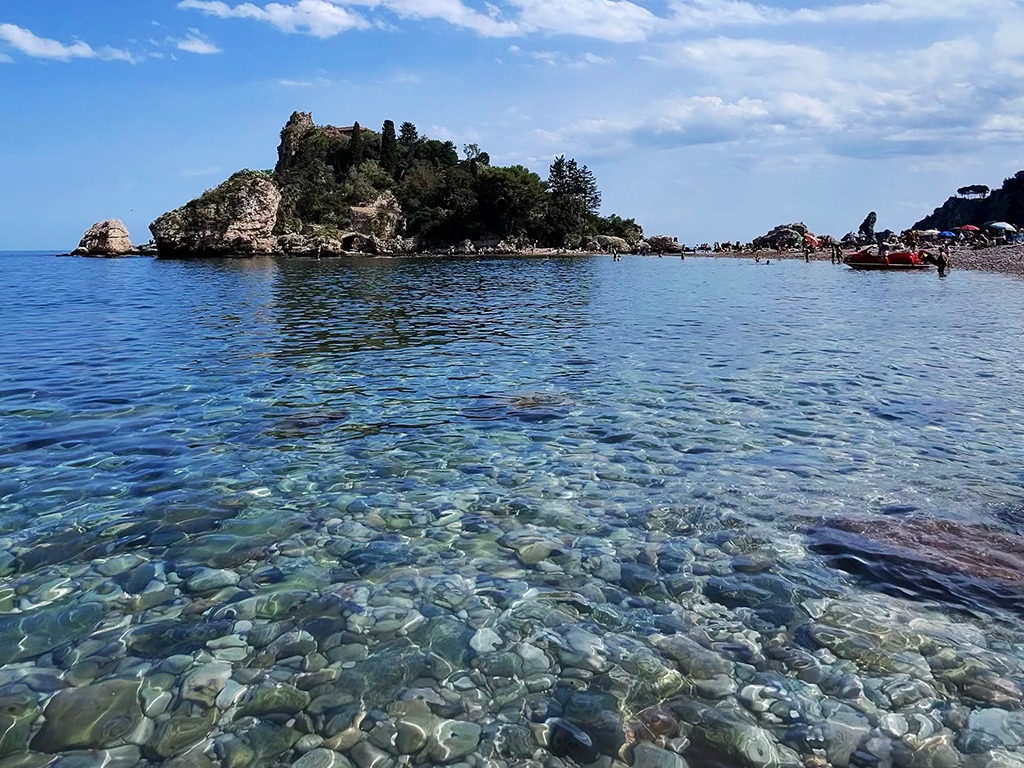
The crystal-clear waters surrounding the island are popular with snorkelers and kayakers, or for a boat trip, offering glimpses of marine life and semi-hidden sea grottoes.
To get to Isola Bella you’ll need to make your way down to the beach (detailed further in the next section), and then cross the tidal spit. There is a small admission kiosk where you can buy tickets on the day of your visit, I’d recommend you bring cash. If you haven’t booked your tickets in advance via the official website, which I generally advise to guarantee entrance (as numbers are limited to protect the island’s nature) and to save time on the day of your visit.
Beyond the green spaces of the town center and nature of the coastline, this area is renowned for epic hiking routes that take walkers high above the town. The spectacular views are rewarding, reaching out to the Ionian Sea and wider area.
The most popular route is the trek up to the Chiesa Madonna della Rocca, a tiny church perched high on the hill above Taormina, and the Castello Saraceno (Saracen Castle, or Castle of Taormina), an ancient fortification that protected Taormina across the centuries. For the more adventurous, extend your hike by heading to Castelmola, a small village right above Taormina, also accessible by bus, where you’ll be rewarded with stunning views of the town and area.
Beaches in and near Taormina
This part of Sicily is famous for its coastline, which contrasts from sandy stretches to pebble filled coves and dramatic cliffs. If time at the beach is on your to-do list in Taormina, like it always is for us, here are your main options:
Isola Bella & Mazzarò
Less than a 10-minute walk from the Mazzarò cable car station (which connects the beach and coast area of Taormina to the historic center), turning right along Via Nazionale and then heading down a set of fairly steep stone stairs, you’ll find this small but pretty stretch of pebbles and the tidal path that joins Isola Bella to the main coast.
While there is a small section of “free beach” that anyone can sit/lie on without cost, most of this cove is taken up by beach clubs offering bed and umbrella rental from May through to October typically. Mine and Sara’s favourite beach club here is the Mendola who offer beds right on the crystal clear water.

We also love the Mendola Beach Club for their restaurant which serves some of the best seafood in Taormina in our experience
Alternatively, within the Mazzarò car park you’ll spot the entrance to a small tunnel that takes you under the SS114 road/Via Nazionale to a different set of stairs that leads to another small bay, slightly north of the one detailed above but still only 10 minutes from the cable car station on foot.
Here you’ll find more beach clubs and a small section of public beach, but a large part of the shoreline is reserved for clients of the large luxury hotels here such as The Atlantis Bay and Mazzarò Sea Palace which means demand for a space on this beach is high.
Regardless of where you decide to pitch up for a day at the beach, I’d recommend arriving early to secure yourself a good spot, and in the event you are opting for one of Taormina’s beach clubs, reserving a bed in advance. Doing so will not only guarantee you your preferred position, but save you time on the day which you can dedicate to relaxing.
Giardini Naxos
If the beaches closest to Taormina aren’t doing it for you, or you want to explore as much of the area’s iconic coastline as possible, heading south along Via Nazionale for 15 minutes via car/bus, or 40 minutes on foot, you’ll find the beaches of Giardini Naxos.
This large stretch of sandy beach offers a more relaxed, family friendly atmosphere with more space than the coves closer to town. You’ll find a mix of beach clubs and free sections, plus plenty of amenities nearby including the Giardini-Taormina train station which makes getting to and from these beaches easy if you are staying further away.
Italian beach culture took Sara and I a while to get our heads around. After living on the Roman coast for years, we’ve now mastered how to navigate sunbed rental, dress codes, swim safety, and everything else you need to fully enjoy Italy’s beaches. We share all of this so you don’t have to learn the hard way in this detailed guide on Napleswise:
For Food and Drink Lovers
Eating and drinking in Taormina, for us, is as much a part of the overall visit experience as the ancient ruins and beaches. Sicilian cuisine is an edible history of the island, influenced by every culture that has passed through and controlled this island, and incidentally, my favourite Italian sub-cuisine.
Few locations offer visitors such a wealth of high quality places to enjoy the famous dishes, wines and produce of Sicily as Taormina does. Here are the must-tries for any foodies and wine lovers coming here, including some specific restaurant and bar recommendations to get your indulgence underway:
Granita and brioche
This is the quintessential Sicilian breakfast, and how I would start every day if I could. Unlike the icy snow cones/slushies found elsewhere, real granita, like what you’ll find universally in Taormina and Sicily, has a smooth, almost creamy texture, even without dairy featuring in authentic recipes.
My go-to place for granita in Taormina is Ai Paladini, a local bar near the steps to and from Isola Bella and Mendola beach. You’ll thank me later.

Order the classic almond (mandorla in Italian) or pistachio, and make sure to get the warm, brioche bun for dipping.
Pasta alla Norma
This dish is a masterclass in simplicity: pasta tossed with rich tomato sauce, fried aubergine, and topped with a generous dusting of ricotta salata (salted, aged ricotta). If you’re in doubt of what to have for lunch one day, do as the Sicilians do; keep things simple by ordering a plate of pasta alla norma.
Arancini
For an inexpensive lunch on the go, enjoyed best at the beach/sightseeing, stop in any bar/cafe in Taormina and order one (or two) of these golden, deep-fried rice balls. In eastern Sicily, they are often shaped like a cone to mimic Mount Etna and while the classic is with meat ragù, I love the pistachio-filled versions popular in the region.
Pesce Spada (Swordfish)
You’ll see swordfish everywhere on menus here, often served “alla ghiotta” (with tomatoes, capers, and olives) or simply grilled with salmoriglio (lemon, garlic, and herb oil). For seafood, I refer back to my previous recommendation of the restaurant at the Mendola Beach Club – there is something special about enjoying fresh seafood with a view of Isola Bella.
Cannoli and/or Cassata
Cannoli, a quintessential Sicilian creation, might now be famous globally but you haven’t had a real cannolo until it’s been filled to order with fresh sheep’s milk ricotta and covered in local chopped nuts. For something even sweeter, try a slice of cassata, a decadent cake filled with sweet ricotta, layered with marzipan and candied fruit – Sara’s favourite!
Etna DOC Wines
Don’t leave Taormina without trying the local volcanic wines, produced from the mineral rich soil of nearby Mount Etna. It’s hard to go wrong when selecting something local, but one of our favourite producers is Benanti, who create reds and whites using only grapes that are 100% native to Mount Etna (Carricante, Nerello Mascalese and Nerello Cappuccio). Head to Bell’Assai restaurant who have a fantastic wine list to try a glass (or bottle) from Benanti, dining and drinking with a sea view.
For more recommendations on where to eat and drink in Taormina, or to find cooking classes, read this guide:
Day Trips from Taormina
One of the many reasons I love Taormina is how easy it is to use as a base for exploring the rest of Sicily and even the southern Italy mainland. Here is a detailed overview of my top three day trip options, including the logistics you need to know to plan excursions without stress:
Siracusa & Ortigia
Following Sicily’s eastern coast south, you’ll arrive at the island’s second largest city; Siracusa. Originally founded by Greek migrants in 734 BC, this city was the main urban center of ancient Sicily.
Over the centuries, Siracusa came to dominate the eastern half of the island, trading extensively across the Mediterranean. This wealth attracted the attention of ancient superpowers, Rome and Carthage, who vied for control over Sicily. This legacy of powerplay is evident in the massive temples, theaters, and ruins found just outside the modern city and within the old heart of Siracusa, the island neighbourhood of Ortigia.
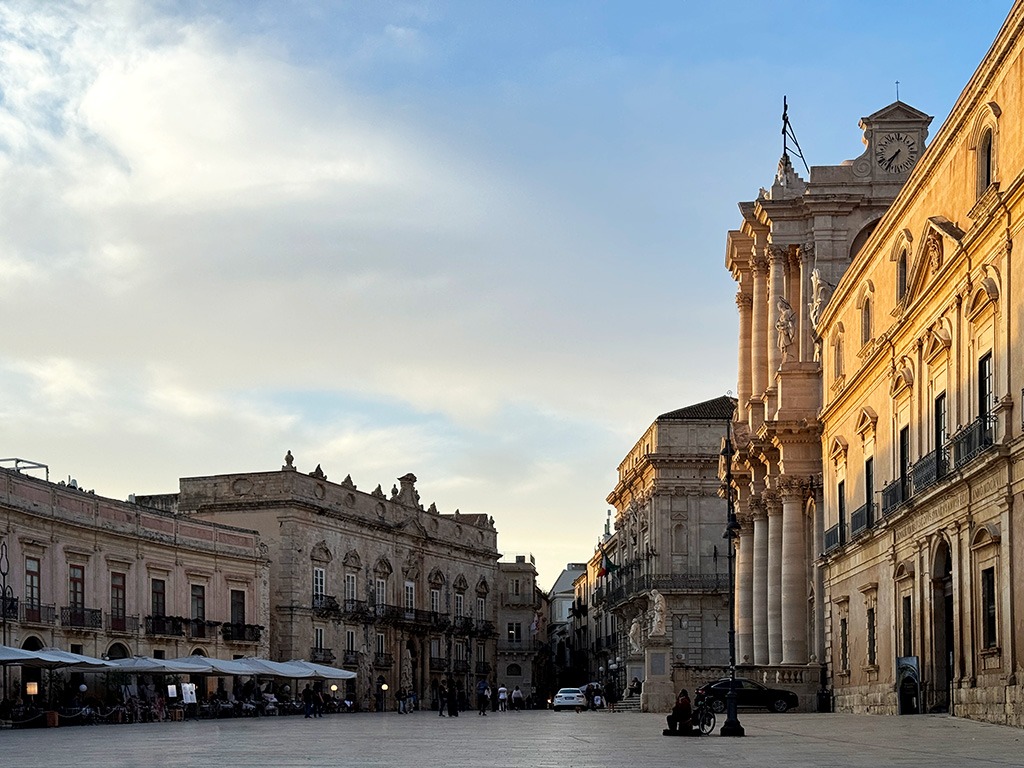
If you can, visit Ortigia in the evening when the sun starts to set and casts a soft light on the local yellow stone, covering the town in a pink hue
Don’t miss:
- the Siracusa Archaeological Park, Neapolis, home to Sicily’s largest theater from antiquity, allowing around 2 hours to visit
- the Archaeological Museum which showcases finds from across the island, one hour visit time
- the stunning Baroque architecture of Ortigia that sits on the original ancient Greek city layout, (half a day recommended to explore at ease)
Getting to Siracusa / Ortigia from Taormina:
By Train: Direct and indirect trains run from Taormina’s train station, Taormina-Giardini, to Siracusa station. Indirect routes usually require a change at Catania, and in either case, the average journey time is around 1 hour 30 minutes to 2 hours. Note that Siracusa’s station is roughly a 25-minute walk from Ortigia (east) and the Neapolis archaeological park (north). I recommend considering a taxi between your points of interest for ease, or using Google Maps to check real time bus options when you arrive.
To find out more about using Italy’s efficient and reliable rail network, including tips on booking tickets, navigating major train stations and the key operators, read my detailed guide here:
By Car: Driving is incredibly straightforward; simply follow the A18 highway south until you arrive at Siracusa. You’ll enjoy epic views of the Ionian Sea on your left and Mount Etna on your right, and the drive time takes about 1 hour 15 minutes. I recommend parking at Parcheggio Von Platen for the archaeological park and museum, and Parcheggio Talete for those heading directly into Ortigia.
Allowing for travel time and the wealth of things to see in Siracusa/Ortigia you should allow a full day for a visit from Taormina.
Reggio Calabria
Across the Ionian Sea lies the region of Calabria, the “toe” of Italy’s boot in southern Italy. The regional capital, Reggio Calabria, is an energy filled city with one of the best regional food scenes I’ve found in mainland Italy.
The highlight of the city is the National Archaeological Museum of Reggio Calabria (Magna Grecia). It houses two of the world’s best preserved ancient bronze statues, the Riace Bronzes, which were discovered by a diver in 1972 just off the coast of Calabria at Riace Marina and restored in Florence in the late 1970s.
For history and art lovers, seeing these statues is worth the trip alone, but the rest of the museum is as equally deserving of your attention where it hosts finds from across southern Italy, covering the region’s history pre-Rome, from when it was known as ‘Greater Greece’.

If you are happy to travel early, enter the museum when it first opens to enjoy a private viewing of the bronzes before the crowds arrive
Getting to Reggio Calabria from Taormina:
By Train: This is a unique experience where trains ride ferries back and forth between Sicily and the Italian mainland. A train on a ferry? Yes, you read that correct! First, catch a train from Taormina-Giardini to Messina port and then on arrival at the port, your train will be loaded onto a specially adapted ferry to cross the strait. Once you arrive in Reggio Calabria, the museum is about a 20-minute walk along Corso Garibaldi -the city’s main thoroughfare.
By Car: Drive north to the Port of Messina and take the ferry across to Villa San Giovanni in Calabria (approx. 20 mins). You can book tickets in advance or purchase them on the day – where these ferries run 24/7, 365 days a year, there is no shortage of options for the crossing. From there, it’s a short drive to the city center of Reggio Calabria (another 20 mins) and you’ll find plenty of parking within walking distance of the museum.
Driving in Italy isn’t half as bad as some of the stereotypes make out. By understanding a few fundamentals you can explore this incredible country by car, without the stress. Find out everything you need to know about getting on the road in Italy in my detailed guide here:
Allowing around 2-2.5 hours each way for travel, a day trip to Reggio Calabria will take a whole day when factoring in time to explore the National Museum of Magna Grecia fully.
Mount Etna
You cannot visit Taormina without acknowledging the giant in the (metaphorical) room. Etna’s presence is one of the main reasons Taormina is what it is; one of Sicily’s most beautiful towns, where the active volcano provides a stunning backdrop to the town.
Beyond the impact on the area’s geography, the soil of this region and mineral deposits in the sea is why the food and wine here is incomparable. The exception being in and around Naples, owing to the same reasons but in that case, thanks to Mount Vesuvius.
Covering all of the options for how to visit Mount Etna would make this guide considerably longer than it already is (and really warrants its own guide, which I’m in the process of creating), so my recommendation is simple; take a tour or guided experience to the volcano.

Another world awaits you if you opt to visit the slopes of Mount Etna
There is a huge range of options from group experiences to the crater, wine tasting opportunities on the slopes, to hikes through the volcanic landscape.
When it comes to the latter, in 2025 I arranged a private visit with Casa Mia Tours where myself and two friends explored the almost Martian terrain of Mt Etna, scaling 1200m up from our starting point near the village of Milo, completing a 10k loop and exploring lava caves. We ended the experience with an authentic Sicilian aperitivo, honouring Etna with a volcano shaped arancino and a glass of local wine. Find out more here:
For most Mount Etna experiences the travel time to and from Taormina is around 1-1.5 hours each way, so depending on the experience you opt for, you can visit the volcano either as half day or a full day. For a complete overview of Mount Etna experiences, take a look at GetYourGuide here:
To Wrap Up
Taormina may not be as big as Naples or Milan, but it is full of things to do. Whether you visit in the busy summer or the quiet off-season, it has something for everyone. From fascinating history and mouth-watering food to easy day trip connections and some of Italy’s top beaches, you now have a full view of the experiences available. Looking for further recommendations? Contact me here.