

Published:
September 24, 2026
Last updated:
September 28, 2026
No trip to southeastern Sicily would be complete without a visit to one of the island’s greatest historical sites; the Neapolis archaeological park in Syracuse. This sprawling open-air museum, a UNESCO World Heritage site, is home to some of Italy’s most impressive ancient ruins, and visiting them couldn’t be easier. Follow my guidance on this page based on real experience, to understand how to reach the park, what to see, eating and drinking nearby and much more.
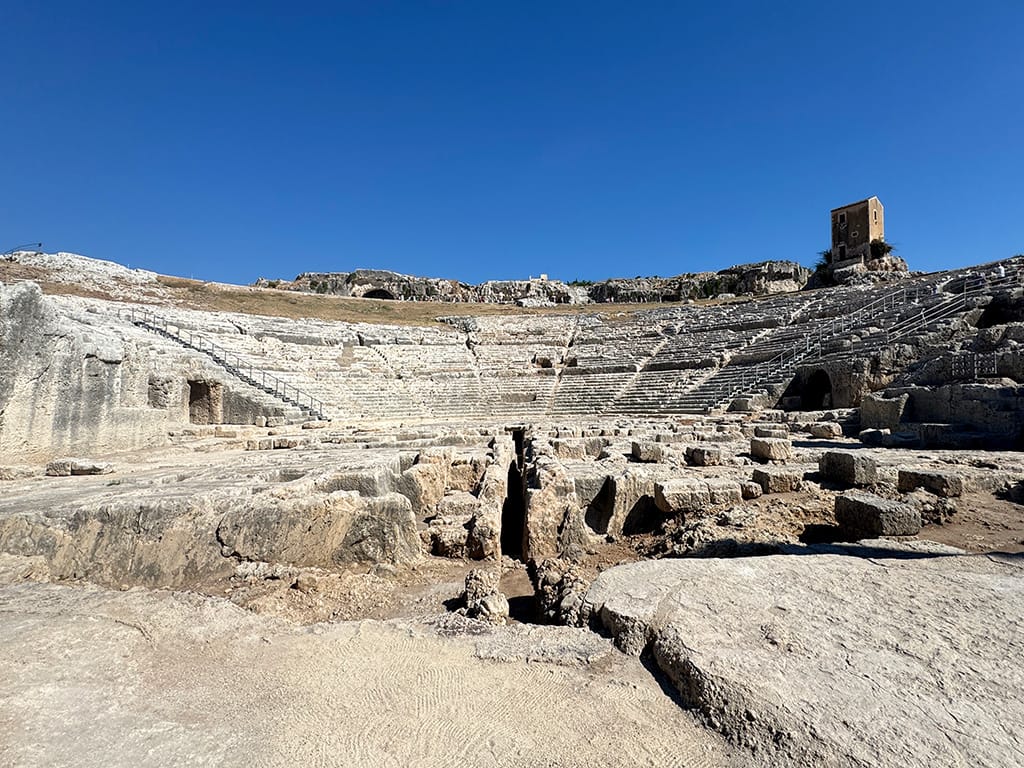
If you enjoy exploring ancient ruins that are immersed in astounding natural beauty, the archaeological park of Neapolis is for you.
The Only Guide to Syracuse’s Parco Archeologico That You Need
From jaw-dropping caves created first as ancient quarries, to some of the largest Greek and Roman monuments in all of Sicily, this site is a history lover’s dream.
What makes the Neapolis park extra special however, is the unique environment that the once-magnificent city now lies in. Following countless earthquakes over the centuries, the landscape has changed dramatically, and creating a secret valley filled with some of the most beautiful plants and special geology that you’ll find anywhere in Europe.
Interested in finding out more, and want to plan your visit? In this guide I will share with you:
- A short history of the ancient city of Neapolis
- FAQs about Syracuse’s archaeological park
- Getting to the Neapolis archaeological park
- What to see at Neapolis
- Tickets and tours of Syracuse’s archaeological park
- Other services and facilities at Neapolis
- Where to eat and drink in and near the park
- Staying near the archaeological park
- A more detailed history of Neapolis and Syracuse
- Bonus: Syracuse Archaeological Museum
Who is this guide for?
I’ve written this guide for anyone considering a visit to the Neapolis archaeological park in Sicily, either as a first time visitor or a returning visitor looking for the most up to date information. Everything in this guide I have personally experienced and verified, and it is correct as of September 28, 2026 when I last updated this post. If you are looking for more Syracuse and/or Ortigia travel guides, click here:
A Short(ish) History of Neapolis Archaeological Park
If you’re already familiar with the history of this spot, or are more interested in this guide’s more practical information on visiting the park, what to see and where to eat nearby, click here to skip this section.
While the area around Neapolis has been inhabited by humans for at least 8000 years (there were even some small Neolithic remains found in the archaeological park), it was in 734 BCE that what we now recognise as the city of Syracuse began to take shape. Ancient colonists from mainland Greece arrived in this corner of southeastern Sicily and founded a settlement on the small island just off the coast of modern day Syracuse. This island would become known as Ortigia.
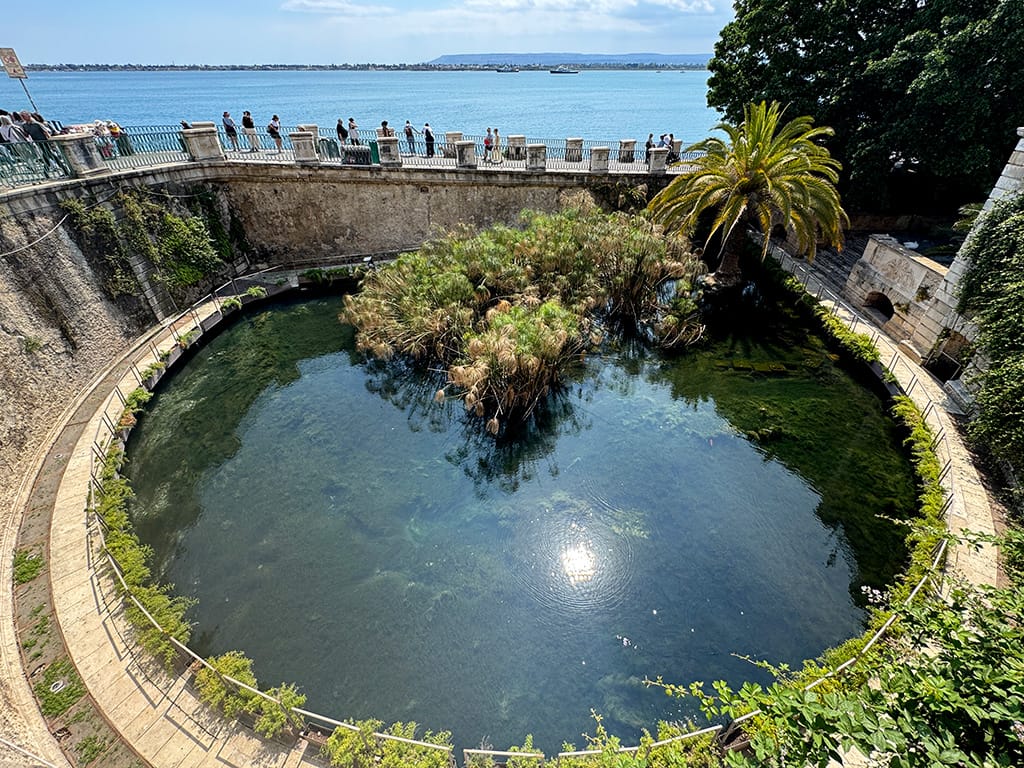
This natural spring in Ortigia is famous in Greek mythology where it plays a central role in the story of Arethusa and her escape from Arcadia. This association is one of the many reasons that Siracusa became one of the most important cities in the ancient Greek world
Not long after, the area inland from Ortigia, near the Teminite Hill, was settled. It was named Neapolis (Greek for ‘new city’), becoming a separate district known from Ortigia, but still part of the overall city of Syracuse.
Syracuse quickly became one of the key cities in the ancient Greek world, growing rich on the trade routes between the east and west Mediterranean. This is evidenced by the impressive monuments that are visible in the archeological park today including the famous Greek theatre.
The city’s independent power however came to abrupt end in 212 BCE when it was conquered by Rome, who ruled Syracuse and the rest of Sicily until the fall of the Western Roman Empire in the late 400s CE. The city remained an important location in Sicily throughout the period of Roman control and was embellished with further grand building projects including the amphitheatre still visible today.
Following Rome’s demise, control of Neapolis moved between different foreign powers over the following centuries. During this period, Neapolis was largely abandoned and ignored by those in charge of this part of Italy. This changed in the first half of the 1500s when Holy Roman Emperor Charles V ordered the destruction of Neapolis’ monuments to use the materials of the ancient structures in his expansion of Ortigia’s sea defences. With this, most of ancient Neapolis was lost and left to be reclaimed by nature, aside from the largest structures. These only survived for the fact they had been carved directly from the Sicilian bedrock.
Private Syracuse & Ortigia Tour | Half Day Experience
Uncover 3,000 years of Syracuse on a private half-day tour, combining the historic streets of Ortigia with the remarkable Neapolis Archaeological Park.

Private Syracuse & Ortigia Tour | Half Day Experience
Uncover 3,000 years of Syracuse on a private half-day tour, combining the historic streets of Ortigia with the remarkable Neapolis Archaeological Park.

Neapolis Today
It wasn’t until the 1800s that Neapolis was ‘rediscovered’ and a series of archeological digs were launched to uncover the ancient city. These excavations were expanded in the late 19th and early 20th centuries when interest in Sicily’s Greek heritage grew, and in 1955, the archaeological area was officially opened to the public.
Today, the Neapolis archaeological park is one of the most important historical sites in southern Italy, and an absolute must-visit for anyone coming to Sicily with an interest in the island’s past. Continue reading to understand how to visit this incredible site, or click here to learn more about Neapolis and Syracusa’s history.
FAQs About Syracuse’s Archaeological Park
Before getting into the latest tips on visiting and what you’ll find in the park, let me share some facts about Neapolis as well as tips for visiting. If you’re already familiar with the ancient city, click here to jump past this section.
Why is it called the "Neapolis" Archaeological Park?
“Neapolis” was the ancient Greek name for the original colony founded here some 2,750 years ago by settlers coming from the Greek mainland. Neapolis means “new city” in ancient Greek, and this name was used liberally across the Mediterranean during this period. The most famous example of this is modern day Naples, which in Italian is Napoli, derived from the same name: Neapolis. Naples was founded by Greek colonists in the same way Syracuse was in the 900s BC.
Where is the Neapolis park?
The archaeological park is located on the outskirts of the modern city of Syracuse in southeastern Sicily, Italy. The entrance to the park is found at the crossroads of Via Ettore Romagnoli, Viale Augusto, Via Luigi Bernabò Besa and Via Francesco Saverio Cavallari, around 1km from the city centre, 2km from the nearest train station (Siracusa), and 15km from the E45 autostrada (motorway/freeway). I’ll share in more detail below how best to get to the park using various transport methods.
When is the best time to visit?
For us, there is both a best time of year to come here and a best time of day. We love visiting Neapolis Archaeological Park in September, and will always come first thing in the morning. September is a great time to visit because there are fewer crowds in autumn, and the late summer light illuminates the ancient rock and stonework vividly. Be sure to visit in the morning to avoid the high temperatures that come later in the day, and no matter the time of year, bring sunscreen and water as shade in some parts of the park is limited.
How long does it take to visit?
A full visit to this site takes 2–3 hours, but history and nature lovers could easily spend a whole day here. Much like other major archaeological sites in Italy, such as Pompeii near Naples or the Valley of the Temples at Agrigento, Neapolis is spread out across a large area. The park measures 240,000m², roughly half the size of Vatican City.
Is Neapolis accessible to visitors with mobility challenges?
For the most part, extensive efforts have been made throughout the park to make the key sites accessible to everyone. However, due to the site’s geography, layers of ancient construction, and centuries of earthquakes changing the landscape, steep ramps are the only way for anyone with a wheelchair or other mobility aids to reach some of the monuments. The park’s paths are generally smooth, but in places you’ll find uneven terrain so sturdy shoes are recommended for all visitors.
Is Neapolis a family friendly attraction?
For the same reasons detailed above, anyone visiting with a buggy/stroller may find some of the paths in the park a challenge to navigate. The park’s large size also means that younger children may struggle to explore fully, and there are no specific programmes for engaging young ones such as treasure hunts, nor any designated play areas.
Is Archimedes buried at Neapolis?
The famous ancient engineer Archimedes is not buried at Neapolis, contrary to the ‘So-called Tomb of Archimedes’ being within the park boundaries. A common historical misconception believes this to be the site of Archimedes’ tomb, and while there are ancient burials in the location, the iconic Syracusan is not among them. The tombs here date from a period long after the death of Archimedes, and the ancient Roman statesman Cicero documented the tomb when he rediscovered it – his writings do not correspond to the modern location.
Getting to Neapolis
The Neapolis Archaeological Park is located on the outskirts of the modern city of Syracuse, meaning getting here couldn’t be easier, no matter your chosen transport method. Here are the main ways of arriving:
Train
Syracuse’s main train station, which connects the city with the rest of Sicily and the Italian mainland (via ferries at the Messina–Villa San Giovanni connection), is located around 2km from the park.
Outside of summer, this walk is straightforward and takes around 30 minutes at an average pace. During the warmer months, I would not recommend walking between the train station and the archaeological park as there is little shade. Instead, jump in a taxi from the rank outside the train station (with a journey time of 10 minutes typically, costing around 15 euros) or use Google Maps to check live bus options on your day of travel – several of the city buses stop right at the park’s entrance.
To find out more about using Italy’s efficient and reliable rail network, including tips on booking tickets, navigating major train stations and the key operators, read my detailed guide here:
Driving
For visitors in Sicily with a vehicle, the park’s out of town location makes driving here super easy. While the park itself doesn’t offer any official parking, you’ll find plenty of pay and display parking spaces on the roads nearby, marked with blue lines.
When Sara and I visit the Neapolis park, we almost always do so by car and will generally park near Bar Milano, one of our go-to places to grab food in the area (more on this below). If we can’t find a spot on the street here, we’ll park at the large and secure Via Aniene car park, roughly 20 minutes from the park entrance on foot. Alternatively, we try our chances at the free parking on Viale Augusto, but this is almost always full.
Driving in Italy isn’t half as bad as some of the stereotypes make out. By understanding a few fundamentals you can explore this incredible country by car, without the stress. Find out everything you need to know about getting on the road in Italy in my detailed guide here:
Tickets and Tours for Syracuse Archaeological Park
Entrance tickets to the park can be booked online via the official website, where it’s also possible to purchase a combination ticket including entrance to the nearby Paolo Orsi Archaeological Museum. I cover this museum in more detail later in this guide – click here to jump to this section. Opting for the combo ticket will save you a few euros compared to purchasing two separate tickets.
While this might be one of Sicily’s top attractions, there is no need to book your ticket in advance if you’re worried about availability. The huge size of the park means it never sells out, and it rarely feels crowded except at some of the main sights.
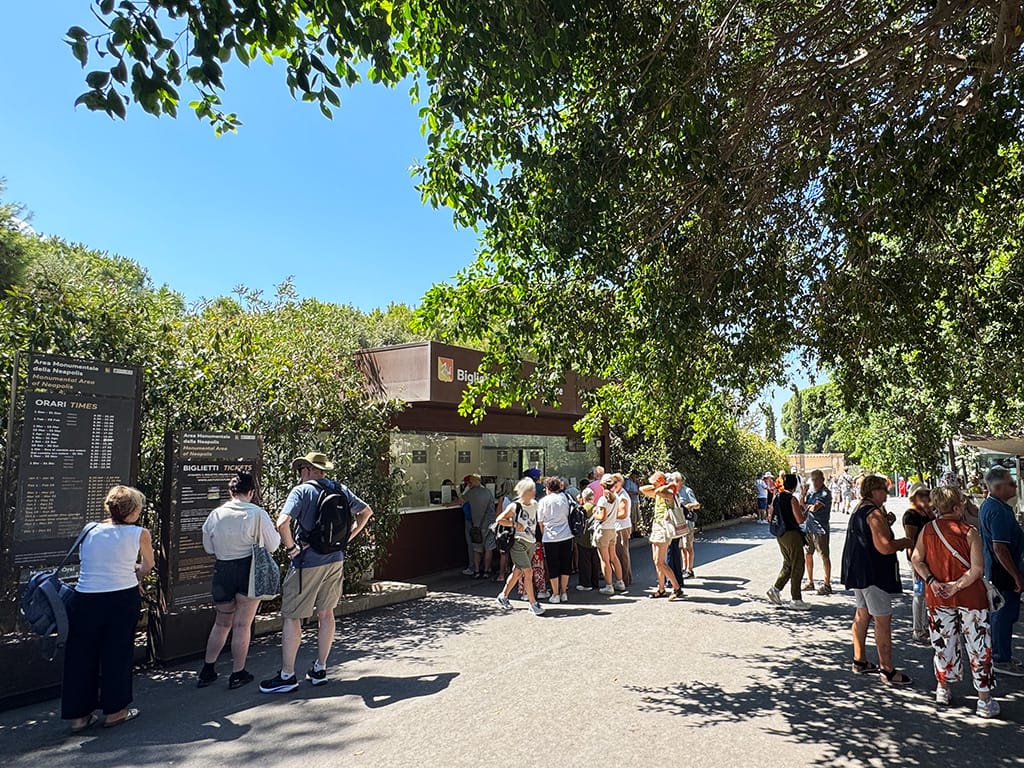
The one benefit of booking in advance is that you can breeze straight into the park, bypassing the two ticket office counters where queues form during popular months
The official ticket office (pictured above) should not be confused with the vendors outside the park in the large open area with market stalls and bars. While these third party sellers are approved, their prices are elevated compared to the official tickets, with the only benefit of using them being that it enables you to bypass any queues at the main office.
You can also purchase entrance tickets via approved online resellers such as GetYourGuide, who also offer audio guides to enhance your visit to the park for a small additional cost. You’ll find a range of tour options online to visit the park with an expert local guide too for a more in-depth experience.
Group tours tend to be available during the tourist season (May-October) whereas private experiences are available year round. If you want to learn as much as possible about this fascinating place, I’d really recommend joining a group tour or booking a bespoke excursion. While guidebooks and audio guides are great, nothing beats local knowledge in my experience.
Tickets and Tours for Syracuse Archaeological Park
The main entrance to the park is found at the junction of Via Ettore Romagnoli, Viale Augusto, Via Luigi Bernabò Besa and Via Francesco Saverio Cavallari, and this is the most common meeting point for guided tours and private experiences. There is also a second, smaller entrance at Viale Guiseppe Agnello, which is useful for anyone with a pre-booked ticket who has limited time, wanting to beeline to the main attractions and avoid the crowds that occasionally gather at the main entrance.
One important thing to note about Neapolis: unlike other major archaeological sites in Italy, such as Herculaneum near Naples or Ostia Antica in Rome, visits to Neapolis are determined by a preset route. This said, you can take as long as you like visiting the monuments, and you do have some flexibility regarding what you see and in what order.
To ensure you see all of the main sites, here is a suggested itinerary that will take most visitors 2–3 hours:
Church of San Nicolò (Chiesa di San Nicolò ai Cordari)
Starting at the main entrance, with the ticket office on your left, take a moment to look at, and more specifically under, the small church on your right. While many other itineraries suggest this as the final stop of a visit to the park, I think appreciating it as you arrive is the perfect bite-sized introduction to the site’s history.
This small church (which you cannot visit inside) sits on top of a cistern dating back to Roman times that collected and stored rainwater for the citizens of Syracuse. Later converted into a late Roman/Byzantine church, the underground structures are even older, representing a Roman reuse of an ancient Greek stone quarry.
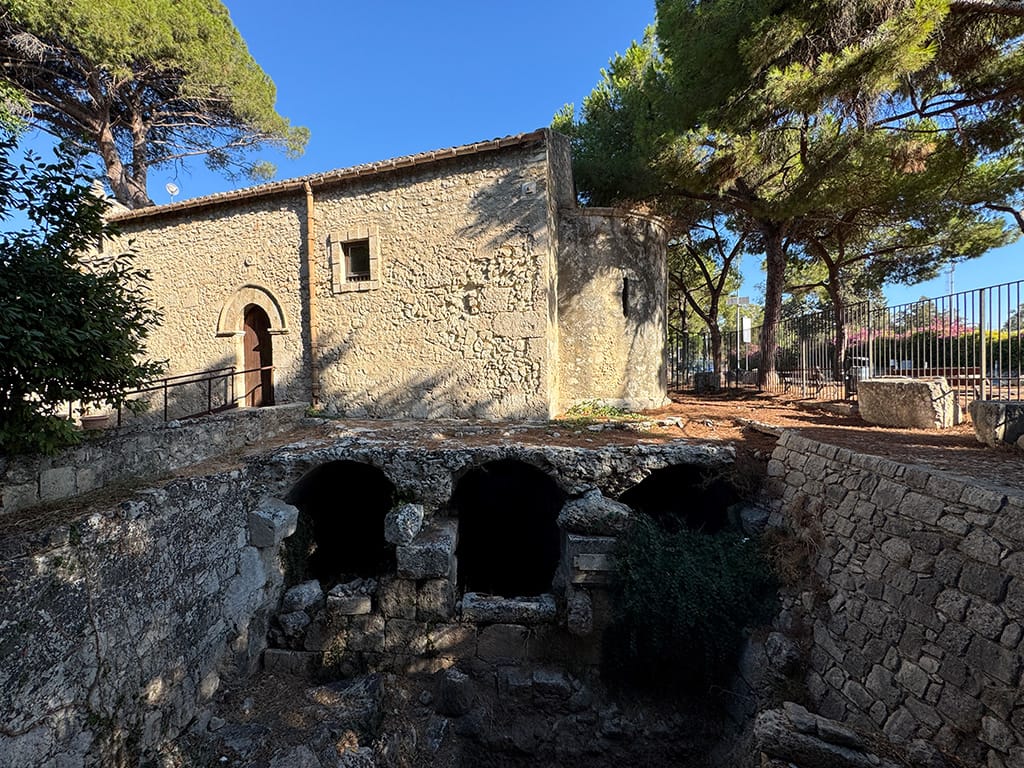
The church that we now see on top of the ancient arches was built in the Norman era, together demonstrating the long and varied history of Syracuse
Roman Amphitheatre
Sticking with the Roman theme, on your right as you proceed into the park – passing the small café on your left – you’ll see signs directing you to ancient Syracuse’s Roman arena. Proceeding through the gate, note the bathrooms to your left (one of two restrooms in the park) and approach the turnstiles to enter this section of the park. Here will be your first ticket check: note that you will be unable to revisit or re-enter this area, so be sure to take your time exploring.
Likely dating from the 1st century CE, estimates from UNESCO put the capacity of this amphitheatre at 15,000-20,000 people, making it the largest in Sicily. While not much of this once impressive structure now exists beyond the foundation carved directly into the Sicilian bedrock, it’s easy to imagine the scale of the arena in its heyday. This is where gladiatorial fights and other forms of entertainment were regularly put on when Syracuse was an important Roman city.
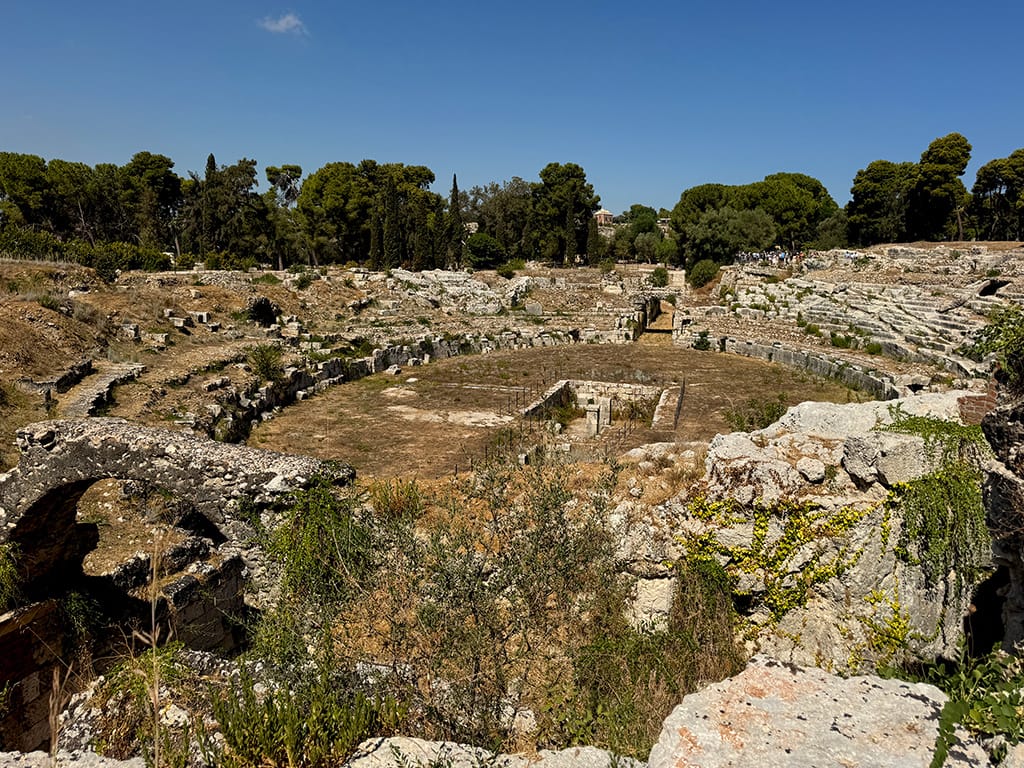
Follow the path around the arena to get a full view of this monument before proceeding to our next stop
Altar of Hieron II
Roughly three-quarters of the way around the amphitheatre, a path to your left will open up that slopes gradually downhill. By following this, you’ll be granted an up-close perspective on a truly unique monument from the ancient world that still survives today.
Constructed in the 3rd century BCE, this huge altar (the biggest of its kind in the ancient Greek world), measuring an incredible 198m long, was used for religious sacrifices on an almost industrial scale. Accounts from the time tell us that up to 450 animals would be killed here, before the population then feasted on the meat during religious festivals.
The scale of this sacrificial platform is the first major testament to Syracuse’s wealth and power that you’ll see today, transporting you back to the city’s ancient golden era. Like the foundation of the Roman amphitheatre, this structure was carved out directly from the bedrock. This ensured not just efficient construction when it was built, but also a high level of preservation as it was very difficult to carry away masonry from it, unlike the fate of many of the other major monuments in Neapolis.
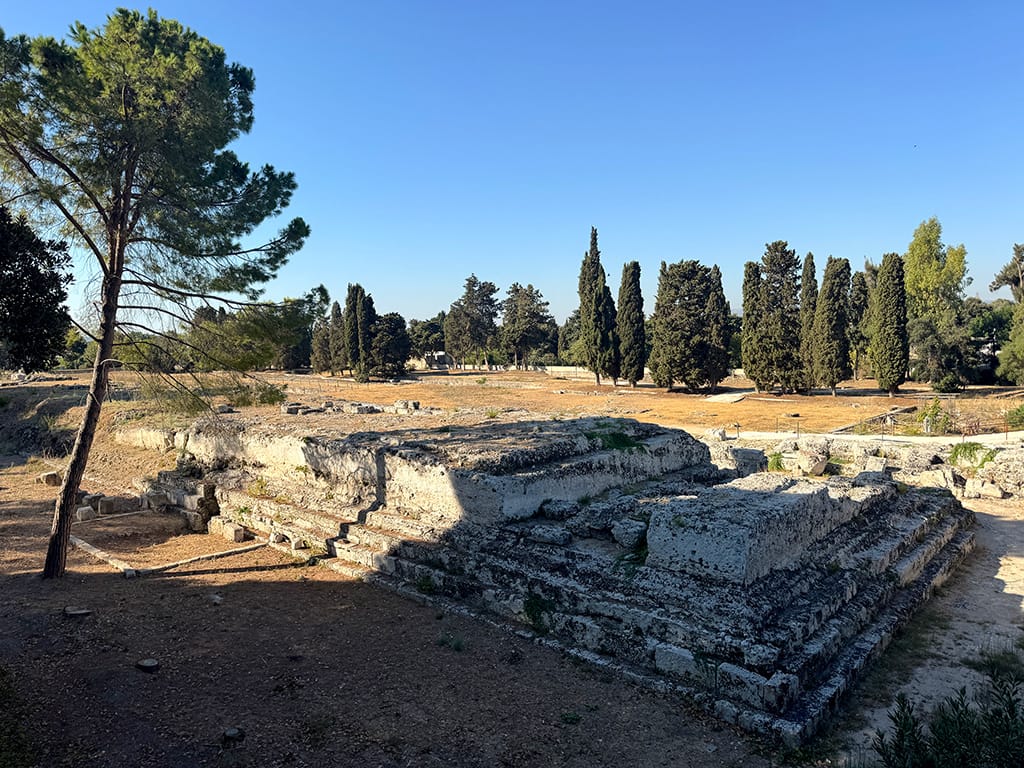
Retrace your footsteps and then return to the main path by exiting through the gate where you entered the amphitheatre area. Take a moment to admire the scale of the Altar of Hieron II from the slightly elevated position as you follow the path downhill.
Gardens of Paradise and Ancient Stone Quarries (Latomie del Paradiso, Cave of the Ropemakers and Saltpetre Cave)
Walking a couple of minutes downhill, passing the small gift shop on your right (you can return here on your way out for souvenirs), you’ll spot the signs for the second ticket check, from where you can visit the rest of the park including the Ear of Dionysius and the Greek Theatre. Like before, you won’t be able to re-visit this part of the park once you’ve exited so be sure to take your time exploring.
Before reaching what are arguably the two most famous sites within the park, you’ll first walk through the aptly called Garden of Paradise. Follow the path as it slopes down into the valley and you’ll soon find yourself immersed in greenery, surrounded by all types of traditional Sicilian flora.
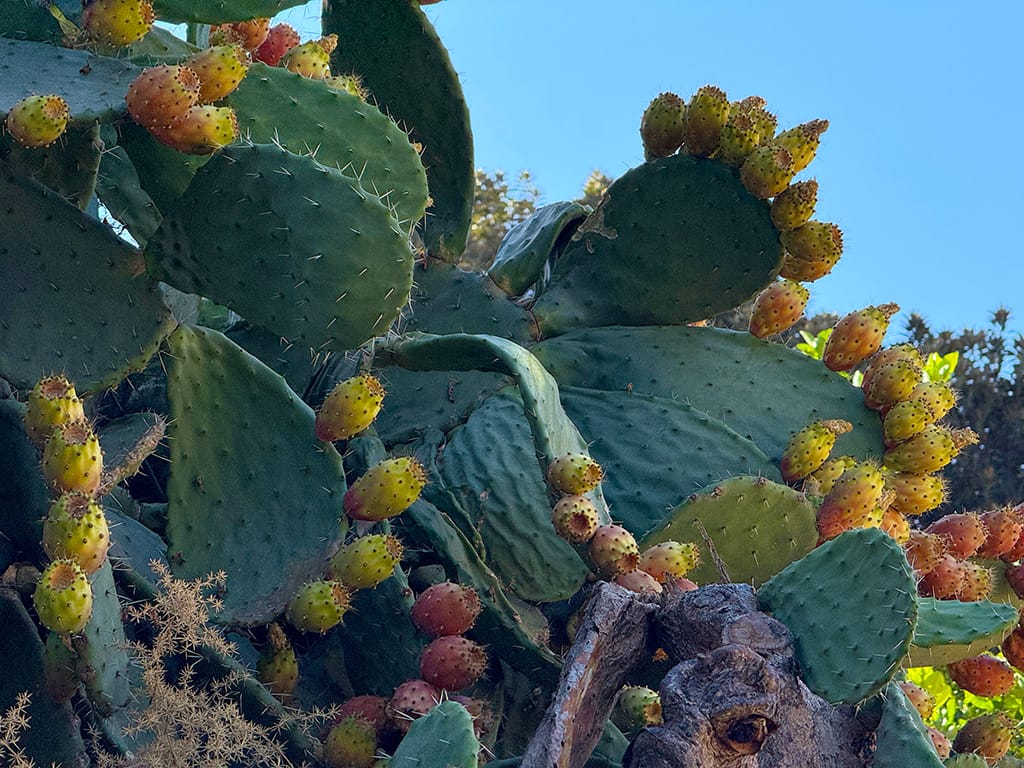
The abundance of fruit trees in this valley is what gave it its nickname many centuries ago, which has now been adopted as the official title for this part of the park
However, what you see here today is not how this area always looked. During ancient times, this entire valley was not in fact a valley, but a huge network of caves created by the Greeks and Romans quarrying out the local stone to use in the city’s constructions.
At an unconfirmed point in past centuries, multiple large earthquakes hit this part of Sicily (possibly those of the 1500s) and caused this quarry system to collapse almost entirely.
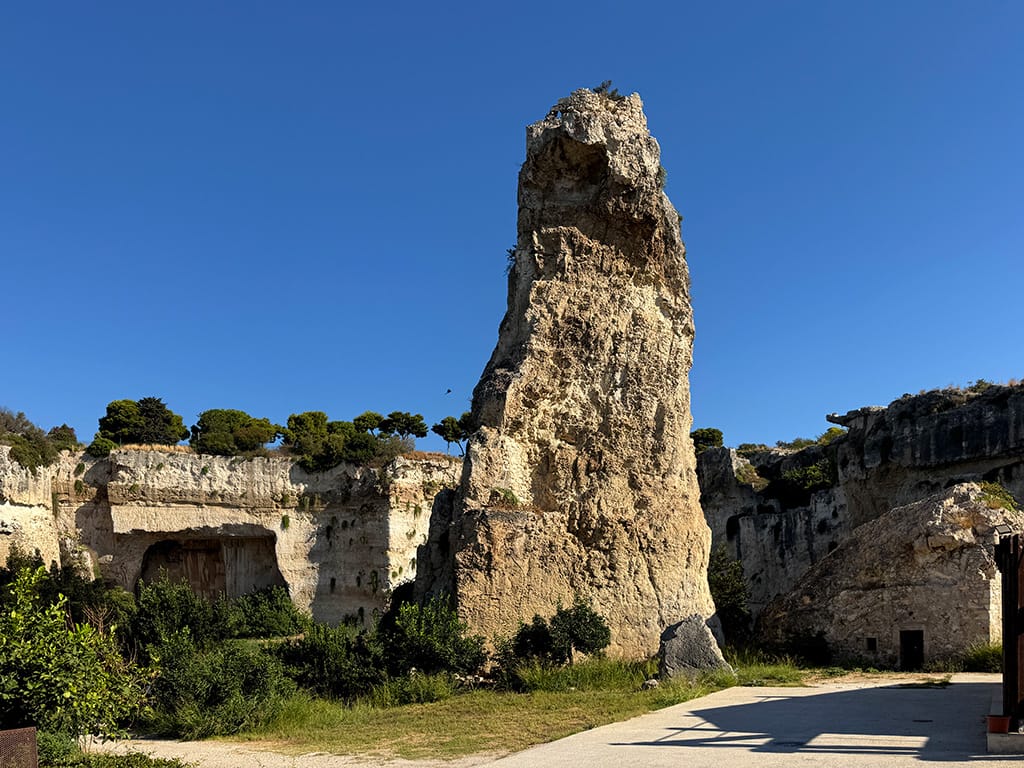
The only clues to this area’s previous state, is the huge stone column that now stands freely in the middle of the garden, and the remaining caves deeper in the hillside
Take a detour to the interior of the two large caves you can go right up to, and appreciate the scale of the ancient quarries. This is also a great place to take a break and cool down during the warmer months as these caverns are shaded and full of fresh water. These are the Cave of the Ropemakers, so-called because it was used in the middle ages by rope craftsmen to create their products in the damp and cool conditions and the Saltpetre Cave. On my last visit the Saltpetre Cave could not be accessed directly, but could still be admired from the outside entrance and from within the Cave of the Ropemakers where the two caverns connect.
Private Syracuse and Noto Tour | Full Day Experience
Spend a day experiencing two sides of south-eastern Sicily, pairing Syracuse’s extraordinary ancient sites with the honey-coloured Baroque splendour of Noto.
Private Syracuse and Noto Tour | Full Day Experience
Spend a day experiencing two sides of south-eastern Sicily, pairing Syracuse’s extraordinary ancient sites with the honey-coloured Baroque splendour of Noto.
Ear of Dionysius
This cave was purportedly named by the famous painter Caravaggio when he was in this part of Sicily in 1608, for one of the city’s ancient rulers, Dionysius. The tradition states that Dionysius would use this quarried hollow as a jail, and then use the natural acoustics exaggerated by the cave’s curving layout (not dissimilar to a human ear canal) to listen in on the prisoner conversations.
While smaller than the other caves in the archaeological area (but still measuring 23m high and 60m deep), the Ear of Dionysius is a personal highlight for me during any visit to Neapolis. I love the history invoked by this unique place: from an ancient tyrant to one of most renowned Renaissance painters (who himself had a reputation for being unpleasant), few spaces can claim such an interesting past.
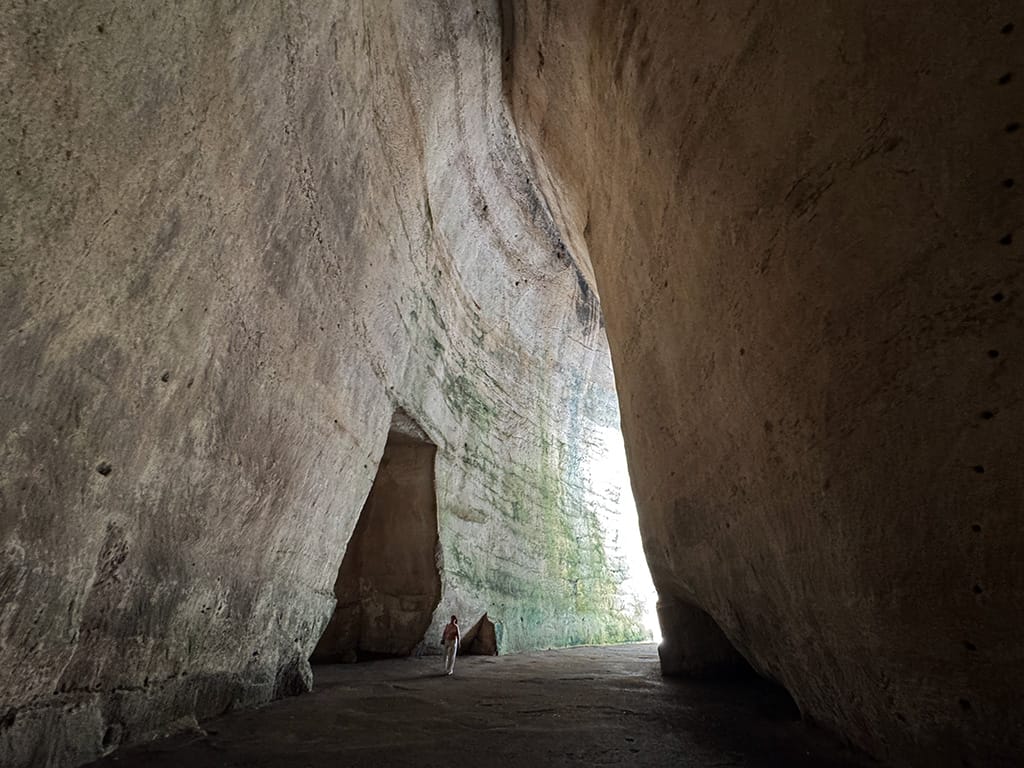
The sheer size of the famous Ear of Dionysius can only be appreciated when inside the cave
The Greek Theatre
It’s now time to see the park’s crown jewel, the ancient Greek theatre of Syracuse. The uphill walk from the Latomia del Paradiso along the park’s main path rewards you not just with uninterrupted views of this ancient structure (the largest of its type in Sicily), but also a panoramic vista of the modern city and harbour of Syracuse, the island of Ortigia, and the Ionian Sea beyond.
Built between the 5th and 3rd centuries BCE at the height of Syracuse’s power, experts believe the theatre could seat between 14,000–16,000 people. This in turn means we can estimate that the population of ancient Syracuse was in the region of 150,000, making it larger than some of Italy’s modern day cities such as Ravenna in Emilia-Romagna or Cagliari in Sardinia.
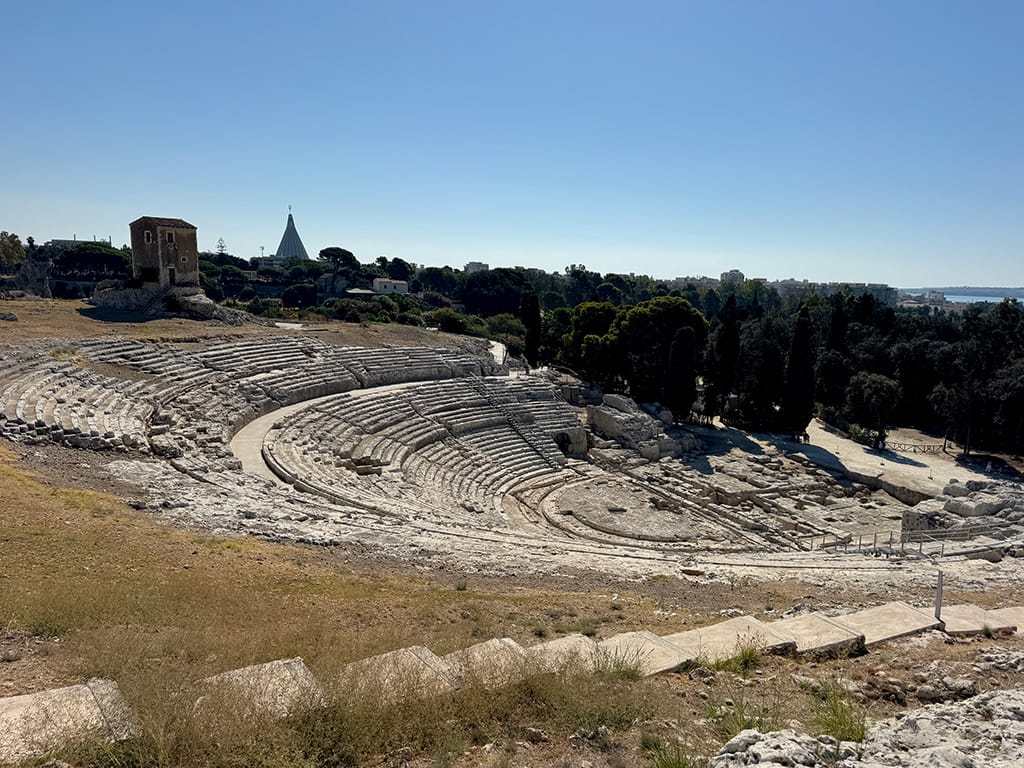
Photos do not do the scale of this site justice, but hopefully the very faint people in the bottom right under the trees help
The theatre is still used today as it was intended originally; for live performances of classical plays during the summer months. Be sure to check the official website here for up to date event listings, as visits during the events season will mean you find large parts of the theatre and surrounding area under cover with modern seating and stage areas. As such, if seeing the theatre in its natural preserved state is a priority for you, be sure to visit outside of summer – the event seating and stages tend to come down in early August.
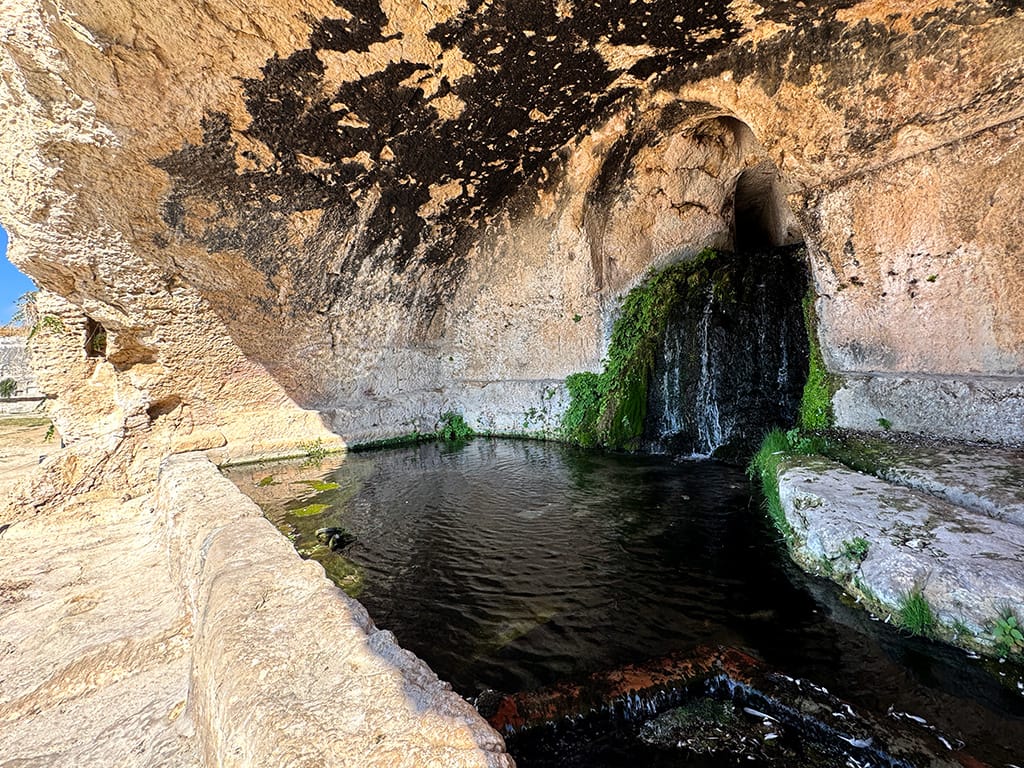
As you follow the path along the top of the theatre, don’t miss the small caves, which were used for early Christian burials, and the outlet of an ancient Greek aqueduct that still brings fresh water here through the rock of the Temenite hill to the nymphaeum pictured above
On Sara and I’s first-ever visit here way back in 2015, we were treated to an impromptu live performance from an opera singer. Encouraged by her friends, she took to a temporary platform that was then over the ancient stage area and began singing. Unfortunately, I didn’t record it but I can assure you that she was incredible. The ancient acoustics of the odeon amplified and projected her voice sublimely, just as the original design intended.
Before making your way back to the main path and ultimately to the park’s exit (stopping via the bookshop and/or café), be sure to view the theatre from ground level.
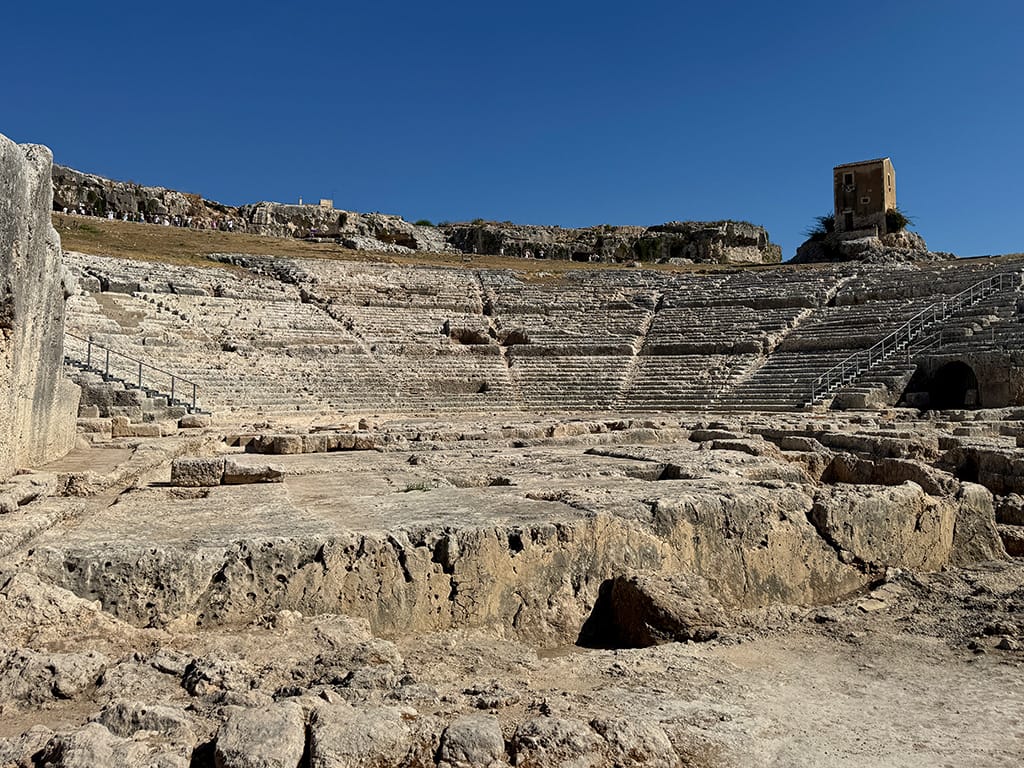
Access to this area can be restricted during the events season, but if it appears open, don’t miss the opportunity to get a perspective of the ancient structure as if you were a Greek or Roman actor
Other Services and Facilities at Neapolis Park
At the Neapolis archaeology park you’ll find a full range of additional services and facilities to help you have an enjoyable visit:
- Café: Right at the main entrance, there’s a small bar with a shaded seating area. This café offers simple and traditional snack options, soft drinks, coffee, ice cream, granita, and a limited range of alcoholic drinks. This bar is open from the moment the park gates open, but note it can get quite busy during peak periods as seating is limited.
- Bookshop: Adjoining the café at the entrance is a small gift shop with a well-curated range of souvenirs including local ceramics, jewellery, and other small items. There is also a good range of books about Syracuse, Ortigia, and Sicily in general, and you can also rent the park’s official audio guide here. The shop opens a little after the main park does, making it a good detour on the way out, as you’ll also find bathrooms for customers here that are less busy than the other restrooms.
- Bathrooms: Speaking of restrooms, there are two main blocks located in the park beyond those in the gift shop. The first is right near the entrance just before you show your ticket to enter the area of the Roman amphitheatre, and the second is slightly tucked away at the base of the Greek theatre.
Unfortunately, the park does not currently have any bag drop facilities, so if you’re travelling with luggage, you’ll need to find storage nearby independently.
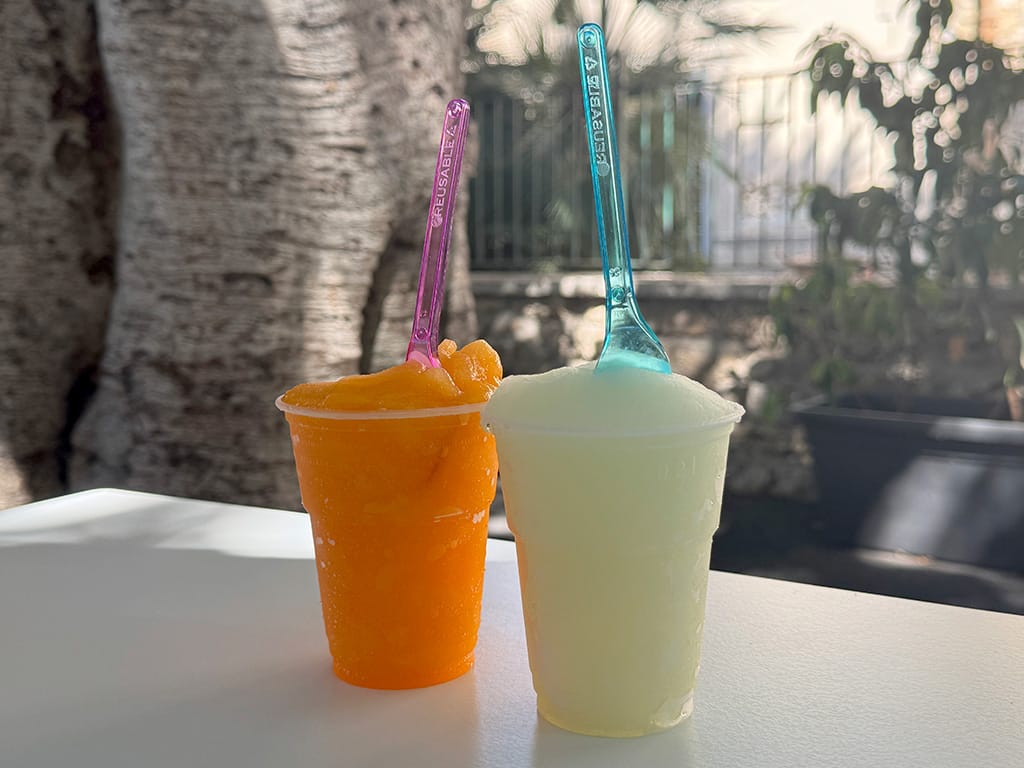
Refresh before, during or after a visit to the park with a granita from the small cafe near the main entrance
Where to Eat Near the Syracuse Archaeological Park
As mentioned above, you’ll find a small bar/café right at the main entrance to the park offering simple snacks and refreshments, as well as a more upscale cafe/bistrot closer to the ancient theatre which opens at 10am daily (excluding Mondays).
Another option is to bring food with you, as you’ll find plenty of peaceful and shaded spots in the Garden of Paradise to sit and eat. Our favourite place to grab something easy and quick close to Neapolis is Bar Milano around 10 minutes walking from the park’s main entrance.
I previously recommended this bar as a location to park near, so by following that guidance, you can kill two birds with one stone. This is a traditional Italian bar/café offering a range of simple takeaway and sit down options such as arancini and fried pizzas, and they also have a wide range of 100% gluten-free sweet and savoury choices.
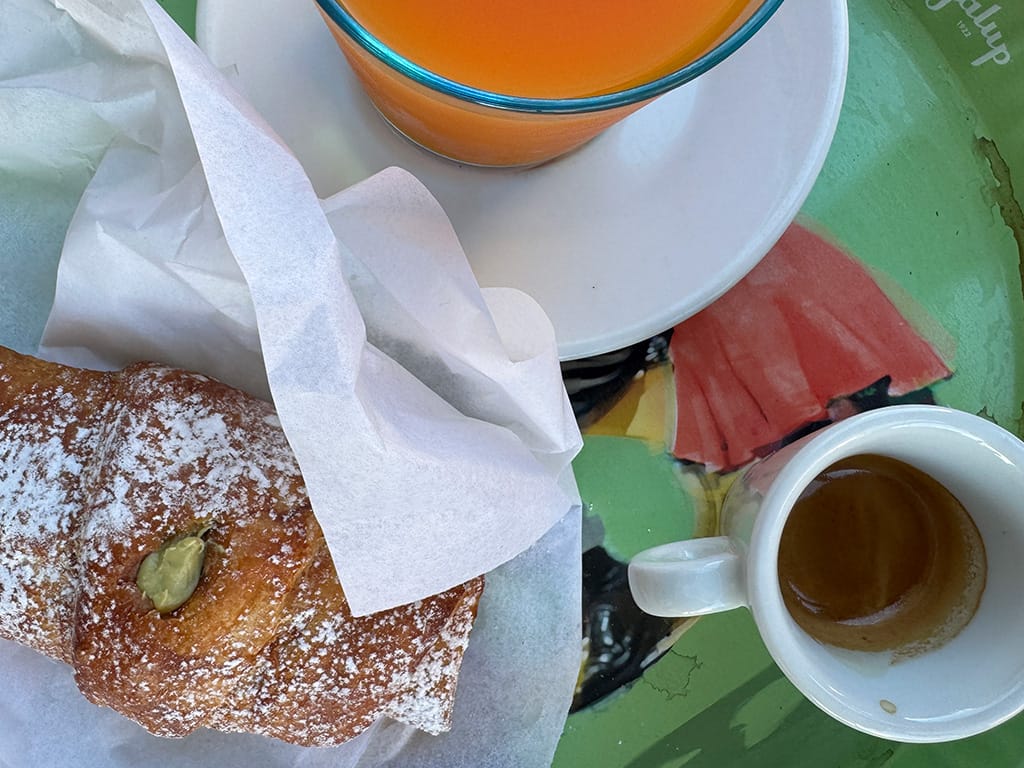
At the very least, do yourself a favour and grab breakfast from Bar Milano – a slight detour is worth it for some of the best pastries and coffee I’ve found in Sicily yet!
Note that right outside the main entrance to the park (across the street, close to the bus/coach parking), you’ll see a series of bars and cafés interspersed with stalls offering cheap souvenirs. Unfortunately, I cannot recommend these as somewhere to eat, even being conveniently located, as the quality of the food on offer is far below that available inside the park or nearby. I’m including details of this location in this guide, however, as they are a useful spot to grab water or other drinks if the café in the park is busy or if you are pressed for time when entering or exiting the park.
For anyone visiting Neapolis with a car, or for those combining a morning visit to the park with an afternoon trip to Ortigia, I’d recommend heading to Fratelli Burgio on the edge of Ortigia island. Conveniently located right next to my recommended parking in Ortigia at Riva Nazario Sauro, this alimentari is famous for its range of mouthwatering sandwiches made from the best quality Sicilian and Southern Italian ingredients.

If you’re not looking to eat at that moment, grab a sandwich to enjoy later, or pick up something else from their deli counter or shelves packed with artisan food and drink products
Staying Near Syracuse Archaeological Park
If visiting this famous site is one of the top priorities for your time in Sicily, you may want to consider staying nearby to minimise transit time to and from the park.
While there are plenty of accommodation options in the immediate vicinity of the park (mostly self-catering apartment rentals and traditional medium-sized hotels), I wouldn’t recommend staying here. While perfectly safe and convenient in my experience, unfortunately this area lacks a variety of places to eat and drink if you’re looking to be based here for multiple nights.
Instead, I would recommend staying in the neighbourhood of Ortigia, the historic centre of Syracuse where the city was originally founded some 2700 years ago. Crossing the small bridge that connects the modern city with this island district you’ll find yourself in one of the most picturesque places in all of Italy.
Beyond the beautiful Baroque architecture that abounds in Ortigia, you’ll find near endless places to eat and drink, from street food markets to high-end restaurants with sea views, as well as some of Sicily’s best shopping. Accommodation on the island consists mostly of small hotels, boutique B&Bs, and apartment rentals. With multiple buses running between Ortigia and the area of the Neapolis Archaeological Park, getting to and from the main sights of Syracuse is easy.
Ortigia is as deserving of your time as the archaeological park, and I recommend that anyone coming to eastern Sicily spend at least one full day exploring this historic place. If you’re interested in understanding what a day in Ortigia might look like, take a look at this guide:
A more detailed history of Neapolis and Syracuse
This area of Sicily has been inhabited by humans since at least 6000 BCE where early people subsisted on the land and sea’s natural resources. Skip forward 5000 years to the first millenium BCE, colonists and traders from Greece began exploring beyond the Greek mainland in search of locations for new settlements. The area that would become Neapolis and Syracuse was settled in 734 BCE when the first colonists established a small town on the island of Ortigia. Ortigia quickly outgrew the confines of the island, and a ‘new city’ (‘Neapolis’ in Greek) was established across the narrow spit on the Sicilian mainland and the collective city came to be known as Syracuse.
Greek Syracuse
Over the following centuries, Syracuse grew larger and wealthier thanks to its strong position on the east-to-west trade routes across the Mediterranean. With this wealth, Syracuse’s power came to dominate not just the immediate area, but also further inland. The people of Syracuse founded their own colonies such as Akrai some 40km away (modern-day Palazzolo Acreide in the Val di Noto). Ultimately Syracuse came to control most of southeastern Sicily, and even parts of southern Italy in modern day Calabria.
By the 400s BC, Syracuse was one of the dominant powers in the Greek world, even being able to resoundingly defeat Athens as part of the Peloponnesian War during the so-called The Sicilian Expedition. As part of this victory, Syracuse enslaved an estimated 7000 Athenians and allied troops who were brought to the city and forced to work in the infamous quarries to construct many of the city’s monuments.
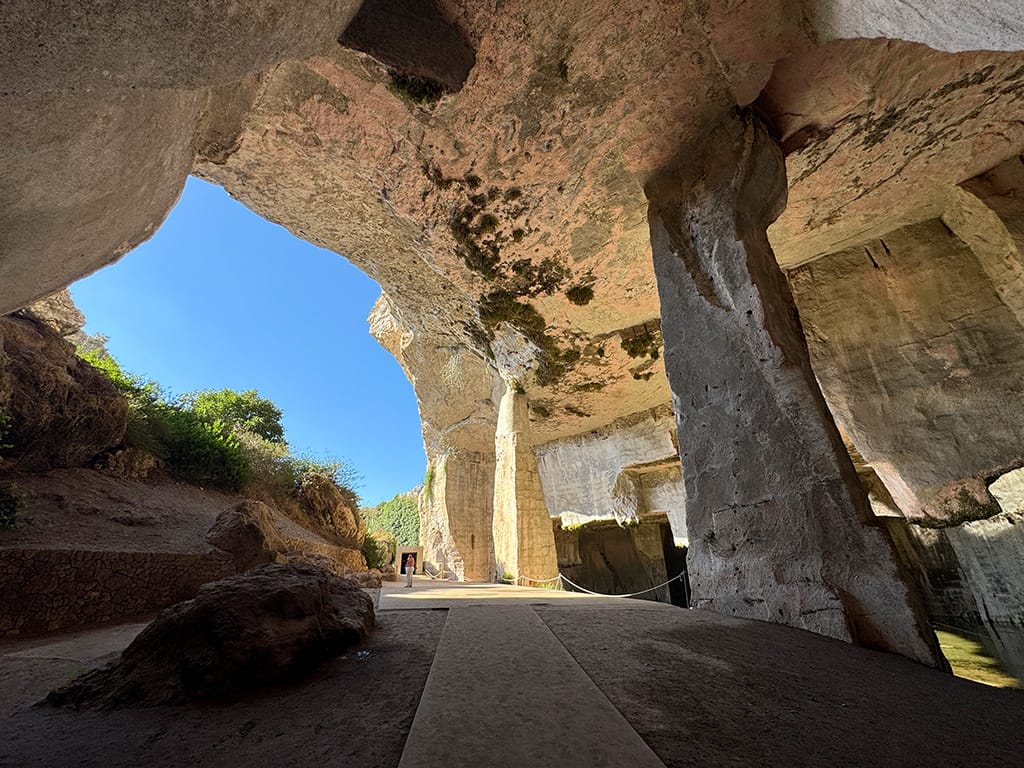
The Cave of the Ropemakers is just one of several large hollows in the hills here, quarried out in ancient times to build Neapolis. Can you spot Sara?
Syracuse’s wealth, power, and strategic position in the centre of the Mediterranean soon drew the attention of the major powers of the time: Carthage (based out of modern day Tunis) and Rome. Syracuse was able to successfully fend off Carthaginian attempts to conquer the city, and even threatened the Punic capital at one point for mastery of the central Mediterranean, but ultimately fell to the Romans in 212 BCE.
Syracuse in Roman Times
One of ancient history’s most notable figures, Archimedes (who famously discovered and proved the displacement effects of water with his “eureka” moment in the bath), was Syracusan. He supposedly defied Roman soldiers who stormed his house during the siege of the city, telling them he would only surrender when he had finished his work. Enraged, the Roman soldiers killed him on the spot, contrary to their express orders to capture him alive so that his genius could be used by the Romans.
”You have always heard it said that Syracuse is the greatest and the most beautiful of all Greek cities. It is indeed as they say.
Marcus Tullius CiceroRoman Statesman
Under Roman control, the city remained the most important city in Sicily, demonstrated by the construction of the large amphitheatre still visible today (the largest on the island). Following the collapse of the Western Roman Empire with the deposition of emperor Romulus Augustulus in 476 CE, control of Syracuse changed frequently over the next several centuries. From the Vandals and Goths, to the Eastern Roman Empire (Byzantium), to the Fatimid Caliphate, Syracuse and Sicily as a whole experienced a long period of unrest.
In 1085, Syracuse was conquered by the Normans, who re-established Christian rule over the city and the rest of Sicily. Like many of their predecessors however, their control did not last long in the grand scheme of history. In 1198 Norman rule ended, and the city and Sicily moved between various royal houses and kingdoms of Europe, including the Hohenstaufen from Germany and the Angevins from France.
Spanish Rule
In 1282, Syracuse and the whole of Sicily became part of the Kingdom of Aragon, which in turn merged with the Kingdom of Castile in 1479, creating the modern Spanish kingdom. Between the fall of the Western Roman Empire in the 400s and this period, the importance of Syracuse diminished, leaving the various ancient structures and monuments largely untouched.
This all changed, however, when the ruler of Spain and Holy Roman Emperor, Charles V (1500-1558), ordered the reinforcement of the coastal defences around the island of Ortigia. He recognised Ortigia’s defensive value in his campaigns against the Ottoman and Barbary (Arab north Africa) influence in the central Mediterranean, and expanded the existing city fortifications.
To do this, Charles mandated that the stone from the ancient structures of Neapolis be used to expand Ortigia’s defences. As a result, only the foundations of the largest structures remain visible, and those carved directly into the bedrock. It is these that you can see in the park today that this guide has detailed.
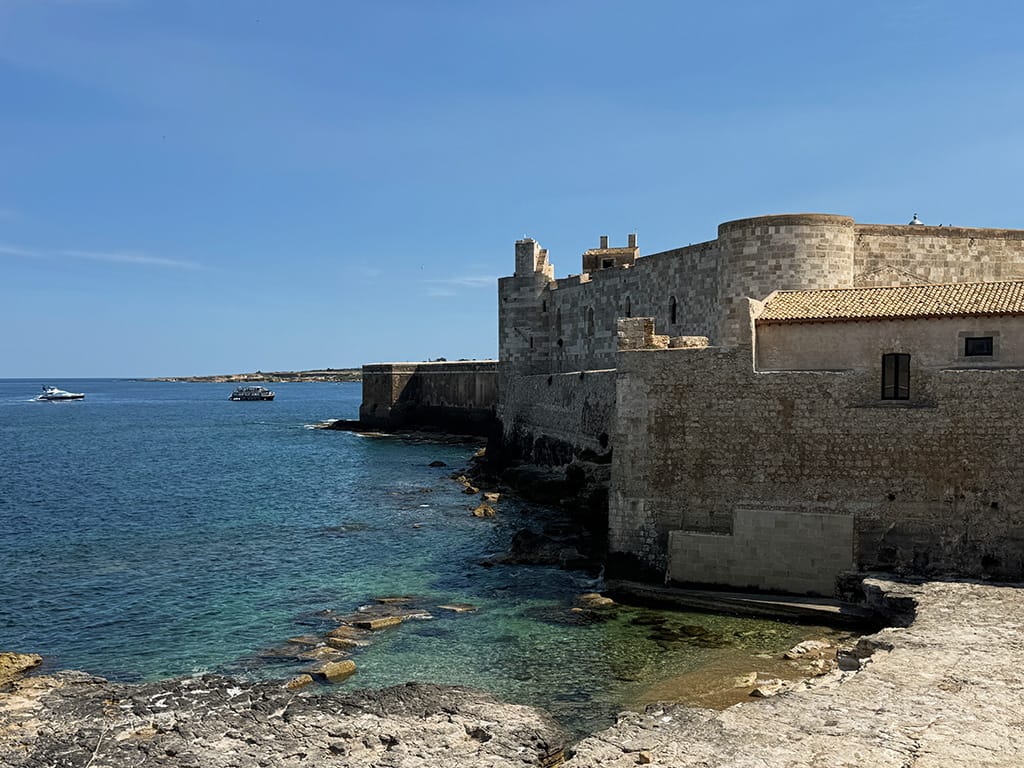
The most visible example of Ortigia’s fortifications that likely used stone from Neapolis is found at Castello Maniace
During this period, a series of natural disasters impacted Syracuse and the wider area, reducing the once magnificent city further. Between the deliberate reuse of stone from the city’s ancient monuments, earthquakes and tsunamis, Syracuse was reduced to a minor town in Sicily.
Spanish control of Syracuse and Sicily as a whole remained constant until the War of the Spanish Succession in 1713 when the Spanish crown ceded control of the island to the Savoyard royal family from northern Italy. Savoy control only lasted until 1718 when the island was reoccupied by Spain. Spain in turn was ousted by the Austrians who ruled Sicily and Naples until 1734, when the whole of southern Italy was once more conquered by Spain.
The Kingdom of the Two Sicilies and Italian Unification
The Spanish installed a cadet (sub) branch of their ruling family, the Bourbons, creating a new Kingdom comprising all of southern Italy. Relative stability returned to this part of Italy until Napoleon conquered the island in 1799, to be defeated by British forces who set up a brief administration of Sicily lasting from 1806 to 1814. Following the final defeat of Napoleon in 1815, a new realm was proclaimed known as the Kingdom of the Two Sicilies. This kingdom covered the land from Naples to Sicily, once more under the Bourbon royal family rule.
It was during this period that a wider interest in ancient Neapolis began to grow. Through the 1830s, excavations led by Domenico Lo Faso Pietrasanta cleared major monuments such as the Greek theatre and Roman amphitheatre.
In 1861, following General Garibaldi’s campaigns to unite Italy, a unified Italian state was proclaimed. Sicily was part of this new state, with the Bourbons being deposed by the Savoys from Turin. During this period, Syracuse was restored and made the provincial capital for southeast Sicily. Combined with the earlier excavations, this helped to restore a small part of the prestige that the ancient city had lost in the prior centuries.
Modern Syracuse
In the late 19th and early 20th century, renowned archaeologist Paolo Orsi conducted further excavations which brought to light many more ancient ruins and monuments. He also directed the founding of the city’s official archaeological museum, curating finds from Neapolis and beyond to become one of the top collections of ancient Greek artefacts in Italy.
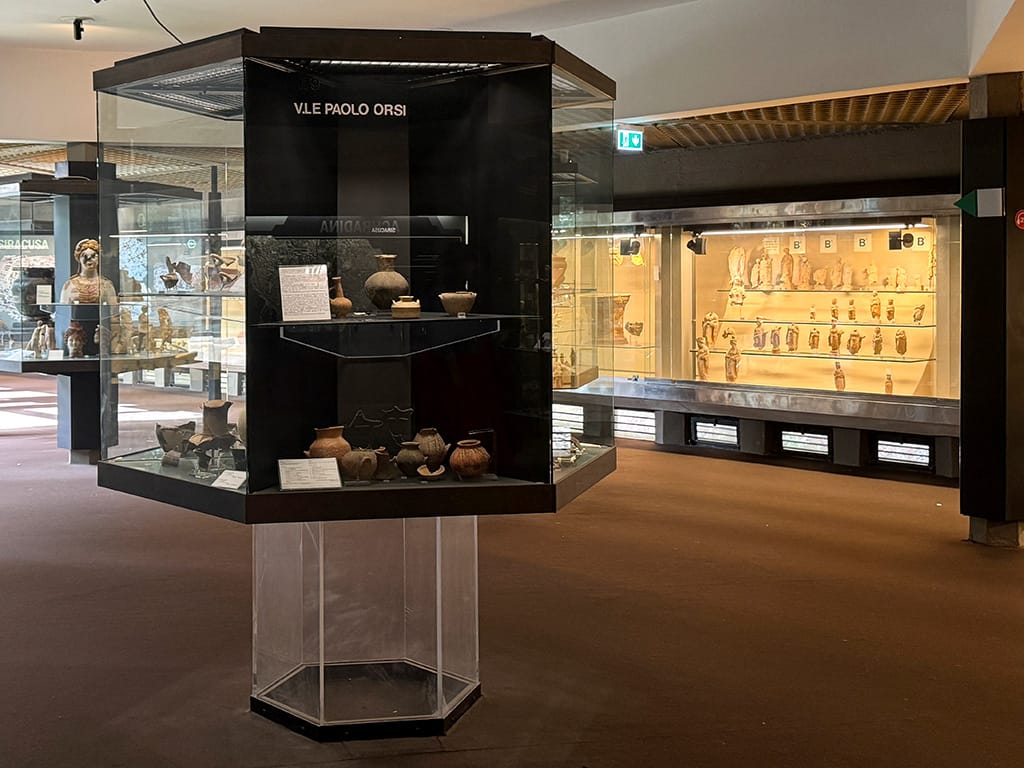
The modern museum, just a short walk from Neapolis, now houses these collections
During World War II, Syracuse suffered from repeated Allied bombing, and came under British occupation on July 10, 1943 as part of Operation Ladbroke during the liberation of Sicily. On September 3, 1943, the first armistice between Italy and the Allied forces was signed not far from Syracuse. Following the conclusion of the war the city began to flourish again, once more becoming one of the most important places in Sicily.
In 1955 the newly organised Parco Archeologico della Neapolis was officially opened, and now is one of Sicily’s top attractions. This, alongside other important sites in Sicily such as the Valley of the Temples in Agrigento, Segesta and Selinunte, serve to showcase the island’s ancient Greek heritage to the world.
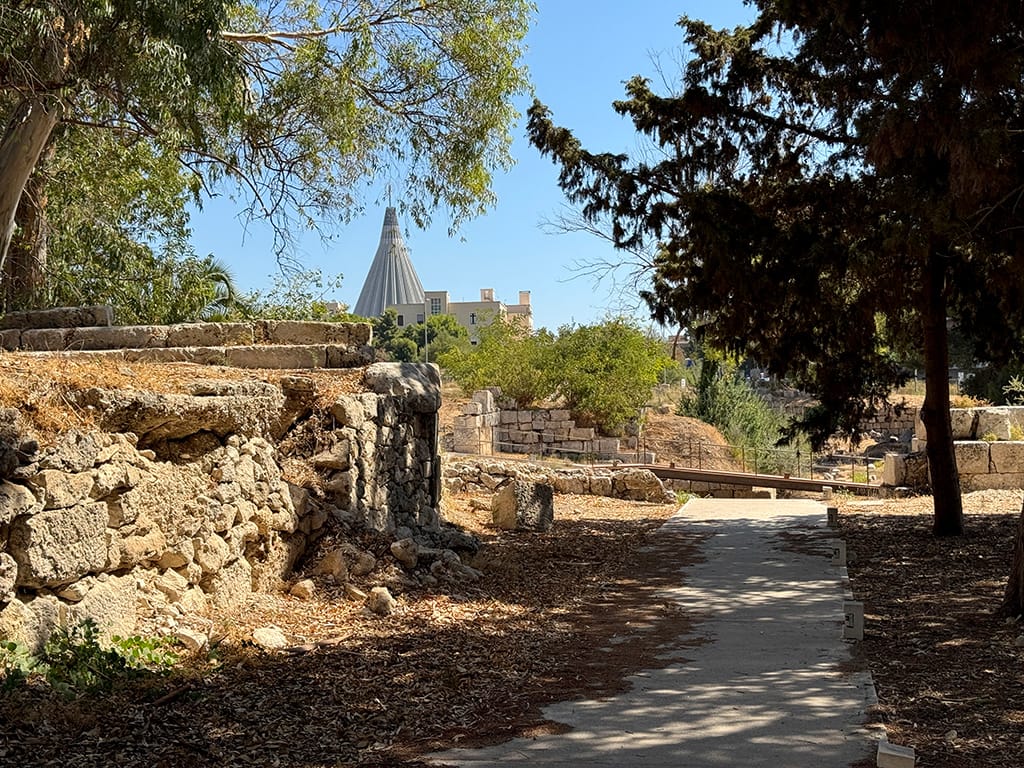
After centuries of misfortune, Syracuse is once again on the up. This city, where the very ancient meets the very modern, is worth your time when in Sicily
Bonus: Syracuse Paolo Orsi Archaeological Museum
Real history lovers should make a point of visiting Syracuse’s archaeological museum to complement a trip to the Neapolis park. Doing so completes the story of ancient Syracuse and the wider Greek world of ancient Sicily and southern Italy.
Not wanting to sugarcoat things, this museum needs some love, which is one of the reasons I encourage anyone with an interest in understanding Sicily’s layered history to go. While the artefacts and exhibitions are world-class, the building the museum is housed in is dated and lacking in maintenance, but with more visitors comes more investment.
If you look beyond the dusty walkways and slightly odd layout, with its recommended itinerary following a mostly circular route around the museum’s three floors, you’ll find the following highlights:
- The Venus Landolina, Venus Anadyomene, a Roman marble statue of the goddess Venus emerging from the sea.
- The Sarcophagus of Adelphia, an extraordinarily detailed 4th-century early Christian marble sarcophagus.
- The Kouros of Megara Hyblaea, a 6th-century BCE archaic Greek marble statue of a young man.
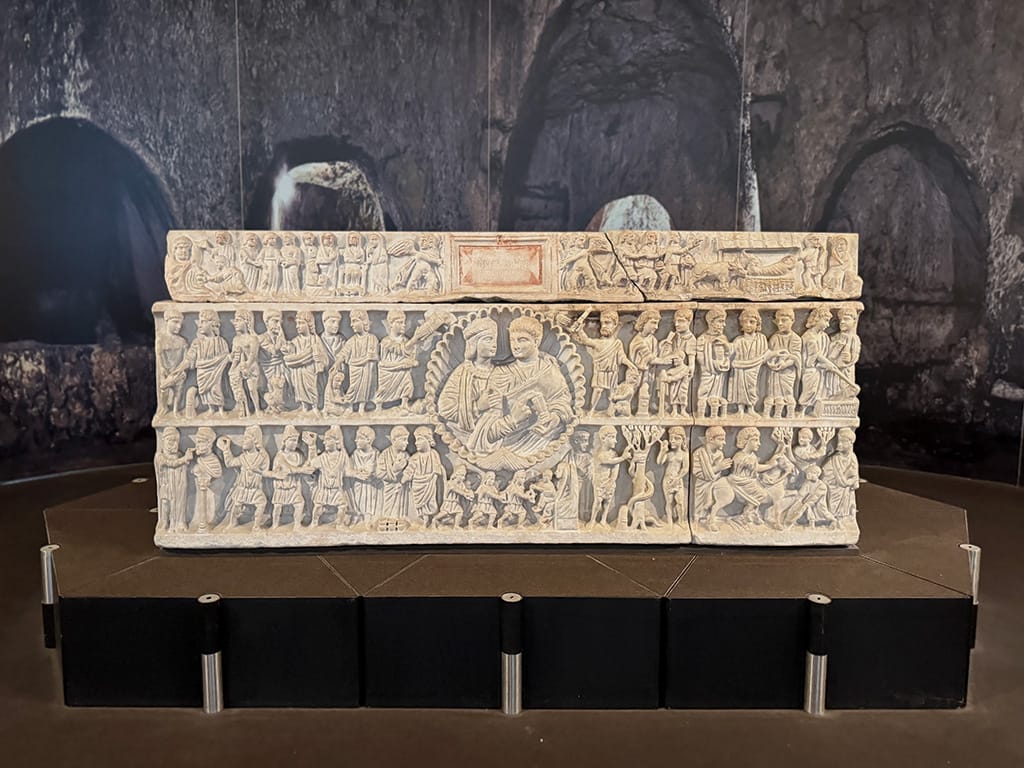
The Sarcophagus of Adelphia is one of the best examples of an early Christian burial from this part of Sicily that still survives to this day
At the museum, you’ll find amenities such as bathrooms and accessibility access (via elevators and ramps), but not much else. There are no café or refreshment facilities, nor a gift shop.
For a full visit to the Syracuse Archaeological Museum you should allow 1–2 hours, making it a good late afternoon option after lunch, especially in the summer when the hot Sicilian weather makes walking around Neapolis more challenging. While the museum lacks some services, it does at least have air conditioning.
You’ll find the museum located at Viale Teocrito 66, around a 10-15 minutes walk from the archaeological park. Located right in the centre of modern Syracuse, you’ll find plenty of public transport options for getting to and from the museum. Check Google Maps on the day of your visit for the best option for you, as timetables can change depending on the day of the week and time of year.
Tickets can be bought in combination with the Neapolis park via the official website, as a standalone entrance, or via approved resellers such as GetYourGuide.
In the End…
The Neapolis Archaeological Park of Syracuse is one of the most important historical sites in Italy and, as such, deserves even a quick visit from anyone coming to southeastern Sicily. The combination of deep history, local legends, and unspoiled nature is unmatched and makes for a fun day out for anyone looking to understand better the south of Italy. If you have any further questions about travelling in Sicily, or elsewhere in Italy, contact me here.